Modernizing Cloud Operations: A Strategic Framework for DevOps Support Services
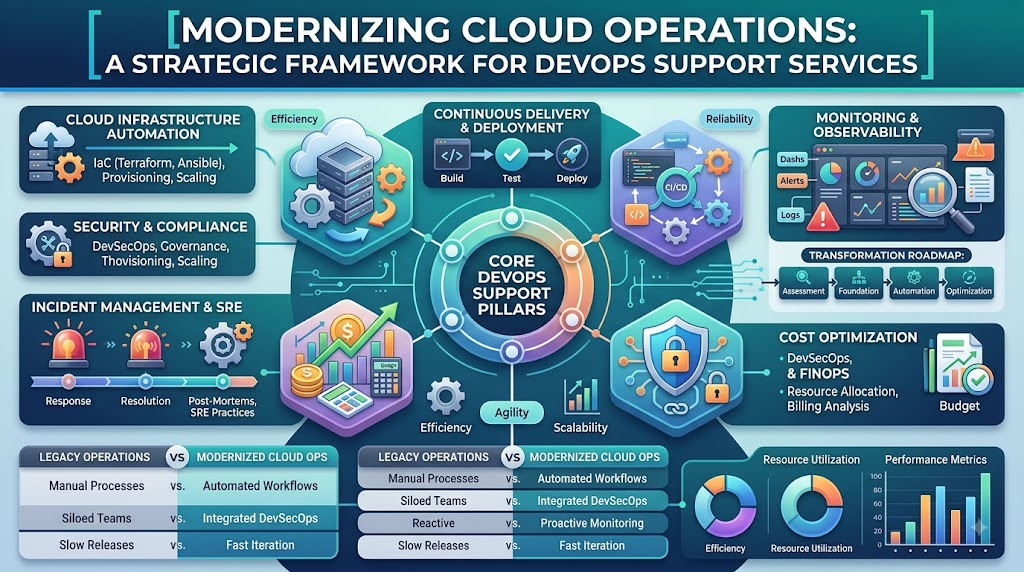
In today’s fast-moving software landscape, technical leaders are constantly challenged to increase delivery velocity while maintaining strict operational stability. As infrastructure architectures shift toward microservices, distributed clouds, and automated deployment pipelines, the sheer operational overhead of maintaining these systems can easily overwhelm internal engineering teams.Achieving sustainable operational excellence requires a structured platform support model. By pairing internal developers with specialized operational assistance, technology organizations can streamline releases, strengthen security compliance, and safeguard system uptime.
What Are DevOps Support Services?
DevOps Support Services provide the dedicated expertise, proactive maintenance, and technical administration required to keep cloud infrastructure and automated release pipelines functioning seamlessly. Instead of treating infrastructure management as an afterthought, structured support establishes continuous oversight across all production environments.
+-------------------------------------------------------------------------------+
|                 Key Pillars of Strategic DevOps Support Services              |
+-------------------------------------------------------------------------------+
|  1. Platform Infrastructure   | Provisioning, IaC Control, & Drift Removal     |
|  2. Continuous Integration    | CI/CD Pipeline Maintenance & Optimization      |
|  3. Cloud Operations          | Multi-Cloud Administration & Resource Tuning   |
|  4. Comprehensive Telemetry   | Metrics, Central Logging, & Tracing           |
|  5. Incident Response         | Escalation Protocols & Rapid Remediation       |
|  6. Resilience & Governance   | DevSecOps Integration & SRE Standards          |
+-------------------------------------------------------------------------------+
The core functional pillars of a complete DevOps support ecosystem include:
- Platform Infrastructure Administration: Managing cloud configurations, enforcing Infrastructure as Code (IaC) standards, and preventing environment drift.
- Continuous Integration & Delivery (CI/CD): Optimizing build workflows, maintaining deployment agents, and ensuring frictionless release cycles.
- Cloud Operations: Managing resource utilization, identity policies, storage frameworks, and networking across public clouds like AWS and Azure.
- Release Management: Orchestrating automated rollouts, canary deployments, and zero-downtime application releases.
- Telemetry and Observability: Implementing real-time monitoring tools, aggregating log streams, and identifying performance bottlenecks before users notice them.
- Incident Triage & Response: Providing rapid technical intervention during unscheduled service degradations or outages.
Project Implementation vs. Continuous DevOps Support
It is crucial for technology executives to separate one-time DevOps implementations from ongoing support services. Implementation projects build the initial foundation—setting up early repositories, provisioning initial cloud clusters, and scripting basic deployment pipelines. Ongoing support, however, manages the real-world complexity of live production platforms.
| Strategic Metric | One-Time DevOps Implementation | Continuous DevOps Support Services |
| Core Objective | Construct initial pipelines, cloud platforms, and IaC tools | Guarantee long-term uptime, security hygiene, and delivery speed |
| Operational Scope | Project-based engagement with a fixed completion timeline | Ongoing strategic partnership with defined SLAs |
| Primary Output | Baseline infrastructure provisioning and initial workflow setup | Continuous incident triage, performance tuning, and maintenance |
| Business Impact | Establishes automated deployment capabilities | Minimizes technical debt, downtime costs, and developer fatigue |
Production environments are living ecosystems. Software libraries require security updates, user traffic spikes demand real-time autoscaling, and cloud vendors frequently update platform APIs. While implementation builds the platform, continuous support ensures it performs reliably over time.
Why Organizations Need Ongoing DevOps Support
Modern software systems are too complex for casual, ad-hoc maintenance. When application engineers are regularly forced to double as cloud administrators, productivity suffers, and context switching slows down feature development.Engineering leadership routinely faces several operational friction points:
[ Fragile Infrastructure ] ----> ( Manual Fixes & Config Drift )
                                         |
[ Operational Overhead ] ------> ( Engineer Burnout & Slow Sprints )
                                         |
[ Specialized Skill Gaps ] ----> ( Unmitigated Security Risks )- Engineering Velocity Loss: When senior developers spend hours fixing broken build runners or investigating cloud network misconfigurations, core product velocity suffers.
- Specialization Gaps: Expecting every developer to be an expert in Kubernetes CNI plugins, IAM policy design, and distributed tracing is impractical and leads to misconfigurations.
- Unpredictable Outages: System failures rarely happen during business hours. Without a structured operational team, incident response becomes chaotic and stressful.
- Configuration Drift: Emergency patches applied manually in cloud consoles lead to untracked environment variations that cause future deployment failures.
Adopting a managed support model creates a productive division of labor. Application developers remain focused on customer-facing features and business logic, while operational specialists handle platform stability, security compliance, and infrastructure management.
24/7 DevOps Support Services
Digital platforms must remain accessible around the clock. A single unhandled infrastructure failure or security breach outside standard working hours can trigger significant business disruption and erode user trust.24/7 DevOps Support Services provide continuous platform protection through structured routines:
- Real-Time Telemetry & Alert Filtering: Monitoring application metrics and system logs continuously, using intelligent alerting rules to filter noise and flag genuine anomalies.
- Immediate Incident Remediation: Maintaining active, around-the-clock engineer rotations to triage and resolve production incidents as soon as they occur.
- Scheduled Release Support: Managing off-peak deployments and maintaining well-defined escalation hierarchies for critical service disruptions.
- Operational Continuity: Ensuring routine tasks—such as database backups, security patch applications, and SSL renewals—happen smoothly behind the scenes.
Maintaining 24/7 platform stability relies on proven operational processes rather than unachievable guarantees. High-performing support operations rely on defined Service Level Agreements (SLAs), clear runbooks, automated failovers, and post-incident root-cause analyses.
Managed DevOps Services
As enterprise platforms expand, building and retaining a full in-house platform engineering team can be resource-intensive. Technology leaders frequently evaluate whether to expand internal headcount or leverage Managed DevOps Services for operational efficiency.Managed DevOps Services offer end-to-end operational execution, setting them apart from traditional advisory consulting.
Ad-Hoc Advisory Consulting ---> Focuses on strategic architecture & periodic reviews
Managed DevOps Services     ---> Delivers daily platform administration & pipeline execution
Key operational functions delivered under managed models include:
- Pipeline Optimization: Maintaining build agents, updating runner environments, and speeding up deployment pipelines.
- Infrastructure as Code Management: Writing, auditing, and updating modular Terraform or OpenTofu scripts for automated provisioning.
- Cloud Resource Governance: Managing identity controls, storage policies, and network security baselines across cloud tenants.
- Automated Security & Patching: Executing regular vulnerability scans, operating system updates, and automated backup verifications.
- Observability Engineering: Maintaining central logging clusters, metrics dashboards, and distributed tracing systems.
Organizations typically choose managed services when they need to rapidly scale platform engineering capacity, access specialized cloud skill sets, or lower administrative overhead. Conversely, companies with highly specialized, proprietary internal systems may prefer to maintain operational control entirely in-house.
Kubernetes Support Services
Container orchestration with Kubernetes has become the baseline for modern microservice architectures. However, operating Kubernetes clusters in production brings complex challenges across networking, storage provisioning, security, and cluster lifecycle management.
+-------------------------------------------------------------------------------+
|                       Kubernetes Operational Landscape                        |
+-------------------------------------------------------------------------------+
                                        |
       +--------------------------------+--------------------------------+
       |                                |                                |
       v                                v                                v
[ Cluster Lifecycle ]         [ Network & Storage Layers ]  [ Workload Management ]
• Control Plane Upgrades      • CNI Plugins (Cilium, Calico)• Ingress & Routing
• Worker Node Maintenance     • CSI Drivers & Volumes      • Horizontal Autoscaling
• API Version Deprecations    • Network Isolation Policies • Resource Requests & OOM
       |                                |                                |
       +--------------------------------+--------------------------------+
                                        |
                                        v
                    [ Operational Vulnerabilities ]
                    • API Deprecations & Breaking Changes
                    • Resource Exhaustion Events
                    • Multi-Cluster Management Complexity
Primary operational friction points in Kubernetes environments include:
- Version Upgrades and Deprecations: Frequent Kubernetes releases require carefully planned upgrades across control planes, worker node pools, and API versions to avoid service disruptions.
- Resource Rightsizing: Poorly configured CPU and memory limits lead to resource waste or cause application pods to crash from Out-Of-Memory (OOM) errors.
- Networking and Storage Management: Troubleshooting Container Network Interfaces (CNI), storage claims, ingress rules, and service meshes requires specialized cluster expertise.
- Cluster Security & Governance: Enforcing Role-Based Access Control (RBAC), pod security standards, and container registry scanning across environments.
Dedicated Kubernetes Support Services help teams run cloud-managed clusters—such as Amazon EKS, Azure AKS, and Google GKE—as well as self-hosted container environments. Specialized support engineers manage control plane upgrades, optimize pod scheduling, fine-tune ingress routing, and troubleshoot cluster errors.
AWS DevOps Support Services
Amazon Web Services (AWS) provides a deep catalog of cloud products. Managing these services effectively requires ongoing oversight across compute, serverless architectures, storage layers, and automated delivery pipelines.AWS DevOps Support Services help organizations maintain, secure, and streamline their AWS operations:
- Compute and Container Management: Administering EC2 instances, Auto Scaling configurations, Amazon EKS clusters, and ECS workloads.
- Infrastructure Provisioning Automation: Authoring and maintaining CloudFormation templates or Terraform scripts to ensure repeatable, audited environment setups.
- Serverless Workload Support: Monitoring and fine-tuning AWS Lambda functions, API Gateways, and event-driven microservices.
- Deployment Pipeline Support: Maintaining AWS CodePipeline, AWS CodeBuild, and third-party delivery tools running within AWS environments.
- Cloud Cost and Health Observability: Using Amazon CloudWatch, AWS X-Ray, and third-party monitoring platforms to monitor performance and optimize cloud spending.
+-------------------------------------------------------------------------------+
|                         AWS Infrastructure Operations                         |
+-------------------------------------------------------------------------------+
  [ Provisioning ]  ---> Terraform / AWS CloudFormation
  [ Compute ]       ---> Amazon EC2 / Amazon EKS / Amazon ECS / AWS Lambda
  [ Delivery ]      ---> AWS CodePipeline / GitHub Actions
  [ Observability ] ---> Amazon CloudWatch / AWS X-Ray
+-------------------------------------------------------------------------------+
Cloud operational practices should always be tailored to specific application requirements. Architecture decisions must account for performance targets, budget parameters, compliance rules, and internal team capabilities.
Azure DevOps Support Services
Microsoft Azure offers a powerful cloud foundation and integrated DevOps tooling for modern enterprise workloads. Organizations building on Azure require specialized operational oversight to manage resources, security profiles, and release pipelines.Core administrative areas covered by Azure DevOps Support Services include:
- Azure Pipelines Management: Designing, optimizing, and maintaining automated build and release pipelines within Azure DevOps.
- Kubernetes and Container Ecosystems: Managing Azure Kubernetes Service (AKS) clusters, container registries, and application routing configurations.
- Infrastructure Automation: Writing and maintaining ARM templates, Bicep modules, or Terraform configurations for automated resource provisioning.
- Azure Infrastructure Administration: Provisioning and maintaining Virtual Machines, Virtual Networks, Key Vault instances, and Application Gateways.
- Monitoring & Diagnostics: Leveraging Azure Monitor, Log Analytics, and Application Insights to maintain complete platform visibility.
Targeted Azure support allows development teams to maintain steady release velocities, enforce platform security policies, and streamline cloud operations.
DevSecOps Support Services
Security must be integrated seamlessly into every phase of the software development lifecycle. Treating security as a final pre-launch checkpoint creates delivery bottlenecks and exposes platforms to avoidable risks.DevSecOps Support Services embed continuous security testing directly into software delivery pipelines:
+-------------------------------------------------------------------------------+
|                       DevSecOps Continuous Pipeline                           |
+-------------------------------------------------------------------------------+
|  Plan  --->  Code  --->  Build  --->  Test  --->  Deploy  --->  Operate       |
|               |            |           |            |              |          |
|               v            v           v            v              v          |
|            [SAST]     [Dependency]  [DAST]     [Container]     [Secrets]      |
|                         [Check]                  [Scan]        [Manager]      |
+-------------------------------------------------------------------------------+- Automated Code Scanning: Integrating Static Application Security Testing (SAST) and Dynamic Application Security Testing (DAST) into CI/CD workflows to identify vulnerabilities early in the development cycle.
- Dependency & Open-Source Auditing: Scanning third-party software libraries and container base images for known vulnerabilities (CVEs).
- Container Environment Security: Enforcing container image signing, registry scanning, and pod security policies inside live Kubernetes environments.
- Secrets Management: Protecting access keys, certificates, and database credentials using secure vaults like HashiCorp Vault, AWS Secrets Manager, or Azure Key Vault, eliminating hardcoded secrets in source repositories.
- Automated Compliance Auditing: Running automated checks to ensure ongoing compliance with industry standards like ISO 27001, SOC 2, HIPAA, or PCI-DSS.
Shifting security left through automated scanning and infrastructure policy checks helps organizations mitigate vulnerabilities without sacrificing development speed.
SRE Support Services
Site Reliability Engineering (SRE) applies software engineering discipline to infrastructure and operational tasks. Rather than relying on manual fixes, SRE focuses on engineering resilient architectures through automation, data telemetry, and structured risk management.Key operational frameworks delivered within SRE Support Services include:
+-------------------------------------------------------------------------------+
|                         Site Reliability Metrics                              |
+-------------------------------------------------------------------------------+
|  Metric                                  | Operational Focus                  |
+------------------------------------------+------------------------------------+
|  SLI (Service Level Indicator)           | Real-time measure of service quality|
|  SLO (Service Level Objective)           | Target performance threshold       |
|  Error Budget                            | Innovation allowance vs stability  |
+-------------------------------------------------------------------------------+- SLI/SLO Management: Defining Service Level Indicators (SLIs) to measure latency, error rates, and throughput, while establishing Service Level Objectives (SLOs) to guide reliability benchmarks.
- Error Budget Allocation: Balancing rapid feature delivery against system availability targets using managed error budgets.
- Advanced Telemetry & Observability: Building monitoring frameworks based on metrics, centralized logging, and distributed tracing to analyze microservice behavior.
- Incident Protocol & Post-Mortems: Establishing clear incident response paths, automated alert routing, and blameless post-mortems to eliminate root causes.
- Capacity Planning & Performance Tuning: Analyzing usage metrics to forecast infrastructure capacity needs and prevent performance degradation during traffic spikes.
Adopting SRE practices enables engineering organizations to maintain high service availability while consistently shipping software updates.
MLOps Support Services
As artificial intelligence and machine learning models move into production, managing machine learning infrastructure presents unique operational challenges. Unlike standard web applications, machine learning platforms must manage code, models, and evolving datasets simultaneously.
+-------------------------------------------------------------------------------+
|                           MLOps Lifecycle Operations                          |
+-------------------------------------------------------------------------------+
|                                                                               |
|  +-------------------+      +--------------------+      +------------------+  |
|  | Data Ingestion &  | ---> | Model Training &   | ---> | Model Deployment |  |
|  | Pipeline Tracking |      | Hyperparameter Tuning     | & Inference APIs |  |
|  +-------------------+      +--------------------+      +------------------+  |
|                                                                  |            |
|                             +--------------------+               |            |
|                             | Monitoring Model & | <-------------+            |
|                             | Data Drift         |                            |
|                             +--------------------+                            |
+-------------------------------------------------------------------------------+
MLOps Support Services provide specialized infrastructure management to support the complete lifecycle of production machine learning systems:
- ML Infrastructure Administration: Provisioning and maintaining compute clusters equipped with specialized hardware, such as GPU acceleration nodes.
- Automated Data & Training Pipelines: Setting up reliable workflows for data processing, feature extraction, model training, and artifact tracking.
- Model Deployment Operations: Deploying ML models into live environments using scalable container endpoints or batch processing pipelines.
- Model Drift & Performance Tracking: Monitoring inference latency, accuracy degradation, and data drift in real time.
- Resource & Cost Optimization: Managing compute resources to prevent cost overruns during intensive training and inference phases.
Dedicated MLOps support bridges data science work and cloud infrastructure engineering, ensuring machine learning pipelines remain automated, performant, and reliable in production environments.
DevOps Support Technology Areas
Modern platform engineering relies on specialized tools designed to automate software delivery and simplify infrastructure administration.
| Technology Domain | Industry-Standard Tooling | Primary Purpose |
| CI/CD Automation | Jenkins, GitHub Actions, GitLab CI/CD, Azure Pipelines, ArgoCD | Automate building, testing, and deploying software packages |
| Cloud Computing | AWS, Microsoft Azure, Google Cloud Platform (GCP) | Provision flexible, scalable cloud compute and storage resources |
| Containers & Orchestration | Docker, Kubernetes, Helm, Amazon EKS, Azure AKS | Standardize runtime environments and manage containerized workloads |
| Infrastructure as Code | Terraform, OpenTofu, AWS CloudFormation, Azure Bicep, Ansible | Automate repeatable infrastructure provisioning and configuration management |
| Observability & Telemetry | Prometheus, Grafana, Datadog, New Relic, ELK Stack, Jaeger | Provide real-time operational visibility through metrics, logs, and traces |
| DevSecOps & Governance | SonarQube, Trivy, Snyk, HashiCorp Vault, AWS Secrets Manager | Scan code, inspect dependencies, manage secrets, and enforce compliance |
| Site Reliability Engineering | PagerDuty, Opsgenie, Chaos Mesh, OpenTelemetry | Manage incidents, track reliability metrics, and conduct failure testing |
| MLOps Technologies | Kubeflow, MLflow, Feast, AWS SageMaker, Ray | Automate machine learning pipelines, model serving, and resource scaling |
Benefits of Continuous DevOps Support
Implementing a structured operational support model delivers clear organizational advantages across technical and executive domains:
+-------------------------------------------------------------------------------+
|                       Benefits of Continuous DevOps Support                   |
+-------------------------------------------------------------------------------+
|  • Rapid Incident Remediation        • Automated Environment Provisioning     |
|  • Predictable Release Cadence       • Reduced Developer Context Switching    |
|  • Proactive Security Controls       • Standardized Observability Telemetry   |
+-------------------------------------------------------------------------------+- Rapid Incident Remediation: Continuous system monitoring enables fast detection, immediate triage, and minimal operational downtime.
- Reduced Engineering Friction: Automating routine platform maintenance, deployment workflows, and security scans frees software developers to focus on core product features.
- Transparent Platform Visibility: Unified logging dashboards, metrics collection, and distributed tracing provide clear insight into system health and cloud costs.
- Predictable Deployments: Automated, standardized CI/CD pipelines reduce release errors and make deployments repeatable.
- Proactive Security Posture: Automated vulnerability scanning, patch management, and strict access controls defend systems against emerging security risks.
- Optimized Infrastructure Spending: Ongoing analysis of cloud resource usage prevents over-provisioning and reduces unnecessary cloud expenditure.
Common DevOps Support Challenges
While external operational support offers significant strategic value, technology leaders must navigate common implementation challenges:
- Incomplete Documentation: Outdated documentation of legacy application behaviors makes rapid troubleshooting difficult for external support engineers.
- Unclear Escalation Boundaries: Ill-defined boundaries between application code bugs and cloud infrastructure issues cause delays during outages.
- Fragmented Observability Tooling: Disconnected logging tools or poorly configured alert thresholds slow down root-cause analysis during incidents.
- Operational Silos: External support operations must collaborate closely with internal developers rather than operating as an isolated unit.
- Uncontrolled Manual Changes: Making direct manual updates in cloud consoles without updating Infrastructure as Code repositories introduces configuration drift.
Overcoming these challenges requires maintaining clear documentation, establishing structured escalation paths, strictly adhering to Infrastructure as Code, and fostering open communication between software developers and operational support engineers.
How to Choose a DevOps Support Company
Selecting an operational support partner requires evaluating their technical depth, operational maturity, and alignment with your business requirements.
+-------------------------------------------------------------------------------+
|                      Partner Evaluation Matrix Checklist                      |
+-------------------------------------------------------------------------------+
|  [ ] Multi-Cloud Proficiency (AWS, Azure, GCP)                                |
|  [ ] Deep Container & Orchestration Expertise (Kubernetes, Docker)            |
|  [ ] Comprehensive Security & Compliance Integration (DevSecOps)            |
|  [ ] Proven Site Reliability Engineering Practices (SRE)                      |
|  [ ] Modern Pipeline Automation Capabilities (CI/CD, IaC)                     |
|  [ ] Structured Response Protocols & Defined SLA Guarantees                   |
|  [ ] Clear Knowledge Transfer Protocols & Documentation Standards             |
+-------------------------------------------------------------------------------+
When evaluating prospective support providers, assess the following criteria:
- Technical Depth: Ensure hands-on experience across major public clouds (AWS, Azure, GCP), container platforms (Kubernetes), IaC tools (Terraform), and delivery systems.
- Embedded DevSecOps Capabilities: Confirm that vulnerability management, access controls, and secrets rotation are built into daily operational routines.
- SRE Maturity: Evaluate how the provider implements observability tools, handles incident responses, and optimizes platform performance.
- MLOps Capability (If Applicable): Ensure proven experience in managing data workflows, hardware acceleration resources (GPUs), and model serving endpoints if your platform uses machine learning.
- Incident Response & SLAs: Review response protocols, escalation hierarchies, and shift coverage models to ensure alignment with operational goals.
- Commitment to Knowledge Transfer: Confirm that the partner prioritizes comprehensive documentation, updated runbooks, and ongoing knowledge sharing with your internal engineering team.
DevOps Support Area and Business Need
| Support Specialty | Primary Business Need |
| DevOps Support | Requires continuous management of cloud infrastructure, deployment pipelines, and operational automation. |
| 24/7 DevOps Support | Needs round-the-clock platform monitoring, rapid alert triage, and emergency incident resolution. |
| Managed DevOps Services | Seeks to offload daily platform management, cloud maintenance, and pipeline administration to specialized teams. |
| Kubernetes Support | Requires expert cluster administration, ingress routing management, network policy enforcement, and version upgrades. |
| AWS DevOps Support | Needs specialized administration of AWS services, including EKS, EC2, Lambda, and CloudFormation infrastructure. |
| Azure DevOps Support | Requires dedicated management of Azure Pipelines, AKS clusters, Bicep/ARM templates, and Azure cloud resources. |
| DevSecOps Support | Seeks to integrate continuous security testing, code scanning, secrets management, and compliance checks into delivery pipelines. |
| SRE Support | Needs to establish reliability benchmarks (SLIs/SLOs), decrease error rates, automate incident triage, and manage capacity planning. |
| MLOps Support | Requires specialized oversight of machine learning infrastructure, model deployment pipelines, and compute cluster management. |
Frequently Asked Questions
What are DevOps Support Services?
DevOps Support Services provide ongoing technical administration, maintenance, and operational assistance for cloud infrastructure, container platforms, CI/CD pipelines, security controls, and telemetry systems to keep applications running reliably.
Why do companies need ongoing DevOps support?
Production cloud systems require continuous maintenance, security updates, resource tuning, and drift correction. Ongoing support manages these tasks so internal developers can stay focused on building core application features.
What is included in 24/7 DevOps Support Services?
Round-the-clock support encompasses continuous system monitoring, automated alert triage, off-hours incident resolution, deployment release support, infrastructure troubleshooting, and system restoration during outages.
What is the difference between managed DevOps and traditional DevOps support?
Managed DevOps Services take on broader operational responsibility for day-to-day cloud administration, infrastructure maintenance, and pipeline management. Traditional DevOps support often focuses on targeted troubleshooting, specific project tasks, or escalation handling.
When should an organization consider Kubernetes support?
Kubernetes support becomes essential when teams run containerized microservices in production and encounter challenges with cluster upgrades, ingress routing, pod scheduling, autoscaling, container security, or multi-node debugging.
What does AWS DevOps support involve?
AWS support covers the administration of compute resources (EC2, ECS, EKS), serverless functions (Lambda), infrastructure code (Terraform, CloudFormation), deployment pipelines, CloudWatch observability setups, and AWS security controls.
How does DevSecOps support improve security?
DevSecOps support embeds automated security controls directly into CI/CD pipelines through static and dynamic code scanning, open-source dependency checks, runtime container security, and centralized secrets management.
What is the role of SRE and MLOps support?
SRE support focuses on system reliability using metrics (SLIs/SLOs), observability tools, error budgets, and incident remediation. MLOps support manages machine learning infrastructure, model deployment pipelines, GPU cluster performance, and model drift tracking.
Conclusion
Modern cloud architectures deliver immense agility, but maintaining them effectively demands disciplined operational management. Connecting cloud infrastructure, container orchestration, deployment pipelines, security automation, site reliability engineering, and machine learning operations requires broad, specialized technical expertise. Organizations that prioritize platform health avoid the unexpected downtime, technical debt, and developer burnout caused by unmanaged infrastructure.Choosing the right operational support structure depends on an organization's technical maturity, infrastructure complexity, cloud footprint, and long-term strategic goals.
