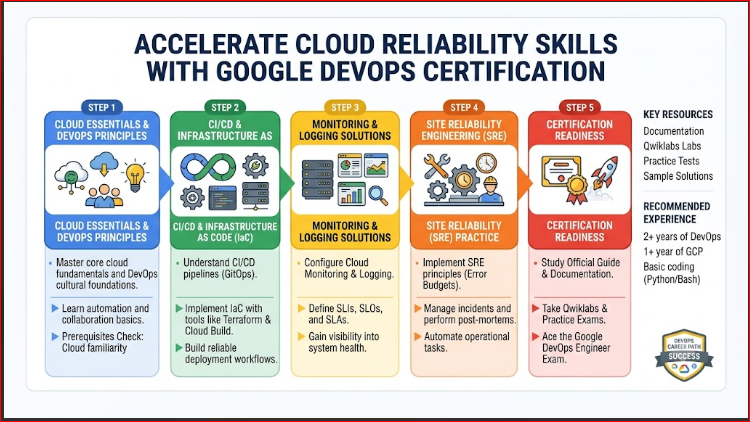
Accelerate Cloud Reliability Skills with Google DevOps Certification
Introduction
Cloud teams today are expected to release faster, reduce incidents, control cloud cost, and keep production systems reliable. The Google Cloud Professional Cloud DevOps Engineer certification helps engineers build these practical skills for modern Google Cloud environments.This certification is useful for professionals who work with CI/CD, SRE, Google Kubernetes Engine, Cloud Build, Cloud Deploy, Cloud Monitoring, logging, automation, incident response, and production reliability. Google describes the Professional Cloud DevOps Engineer as someone who implements processes across the software development lifecycle, balances reliability with delivery speed, and optimizes production systems for performance and cost.
What It Is
The Google Cloud Professional Cloud DevOps Engineer certification is designed for engineers who want to prove their ability to manage DevOps, SRE, CI/CD, observability, automation, and production operations on Google Cloud.In practical terms, it helps learners understand how to build reliable delivery pipelines, monitor systems, troubleshoot issues, reduce deployment risk, and optimize performance and cost on Google Cloud.
Who Should Take It
This certification is suitable for:
- DevOps Engineers working with cloud-native applications.
- Site Reliability Engineers responsible for uptime and incident response.
- Cloud Engineers managing Google Cloud infrastructure.
- Platform Engineers building internal developer platforms.
- Software Engineers moving into DevOps or cloud operations.
- Release Engineers handling CI/CD pipelines.
- Engineering Managers who want to understand Google Cloud DevOps delivery.
- Security Engineers working on secure CI/CD and cloud governance.
- FinOps and Cloud Cost professionals who want to understand performance and cost optimization.
Google lists no mandatory prerequisite for the vendor exam, but it recommends 3+ years of industry experience, including 1+ year designing and managing production systems using Google Cloud. The exam is 2 hours, costs $200 plus applicable tax, and has 50–60 multiple-choice and multiple-select questions.
Google Cloud Professional Cloud DevOps Engineer Certification Overview
The program is delivered via Google Cloud Professional Cloud DevOps Engineer training and hosted on DevOpsSchool. It is structured as a practical training-cum-certification program where learners study Google Cloud DevOps concepts, complete assignments, build capstone projects, and take a final assessment through DevOpsSchool.In practical terms, there are two parts to understand. First, Google Cloud owns the official vendor certification exam, which validates skills in Google Cloud DevOps, SRE, CI/CD, observability, troubleshooting, and cost optimization. Second, DevOpsSchool provides training, labs, mentorship, assignments, capstones, and its own completion certificate to help learners prepare for real-world work and the official Google Cloud exam.The DevOpsSchool structure includes a 5-week learning plan, tool-based modules, live demos, 2 assignments and 1 capstone per tool, and a 3-hour online open-book final exam. Google’s official exam guide covers five major areas: bootstrapping and maintaining a Google Cloud organization, CI/CD pipelines, SRE practices, observability and troubleshooting, and performance and cost optimization.
Certification Levels, Assessment Approach, Ownership, and StructureCertification Level:
Professional-level cloud DevOps certification.
Ownership: The official vendor credential is owned by Google Cloud. DevOpsSchool hosts a training and certification-oriented learning program around the same skill area.
Assessment Approach: Google’s exam uses multiple-choice and multiple-select questions. DevOpsSchool’s program includes assignments, capstones, labs, and a final online open-book exam.
Program Structure: Learners move from foundations to CI/CD, SRE, observability, security, deployment strategies, troubleshooting, performance, and cost optimization.
Practical Focus: The program is useful because DevOps is not only about knowing tools. It is about using tools correctly in production, managing failures, reducing risk, and improving delivery quality.
Skills You’ll Gain
- Google Cloud DevOps fundamentals.
- CI/CD design using Cloud Build, Cloud Deploy, Artifact Registry, and Git-based workflows.
- Infrastructure automation using Terraform and Google Cloud-native tools.
- Google Cloud organization structure, IAM, service accounts, and governance.
- SRE practices such as SLIs, SLOs, SLAs, error budgets, and incident response.
- Deployment strategies such as rolling, canary, blue-green, and rollback.
- Observability using Cloud Monitoring, Cloud Logging, Cloud Trace, dashboards, metrics, and alerts.
- Troubleshooting for application, infrastructure, CI/CD, latency, and reliability issues.
- Secret management, Binary Authorization, vulnerability scanning, and software supply chain security.
- Cost and performance optimization using Google Cloud recommendations and FinOps practices.
Real-World Projects You Should Be Able to Do After It
- Build a CI/CD pipeline for a microservice application on Google Cloud.
- Deploy an application to Google Kubernetes Engine using progressive delivery.
- Create a Google Cloud organization structure with projects, folders, IAM, and policies.
- Set up Artifact Registry and secure deployment workflows.
- Implement canary or blue-green deployment using Cloud Deploy.
- Create monitoring dashboards for production applications.
- Define SLIs, SLOs, alerts, and incident response playbooks.
- Troubleshoot failed deployments, latency problems, and infrastructure issues.
- Manage secrets safely in build and runtime environments.
- Optimize Google Cloud workloads for performance and cost.
Common Mistakes
- Treating DevOps as only CI/CD and ignoring SRE fundamentals.
- Learning tools without understanding production failure scenarios.
- Ignoring IAM, service accounts, and organization-level policies.
- Not practicing Cloud Monitoring, logging, tracing, and alerting.
- Depending only on theory instead of hands-on labs.
- Not understanding rollback, canary, and blue-green deployment patterns.
- Forgetting cost optimization and observability cost control.
- Using admin-level permissions everywhere instead of least privilege.
- Not preparing for scenario-based exam questions.
- Skipping Google Cloud documentation and official exam guide topics.
Best Next Certification After ThisThe best next certification after Google Cloud Professional Cloud DevOps Engineer is usually Google Cloud Professional Cloud Architect. It helps engineers move from DevOps execution to larger cloud architecture decisions, including governance, security, networking, reliability, migration, and enterprise cloud design.For engineers focused on security, the next option can be Google Cloud Professional Cloud Security Engineer. For engineers focused on Kubernetes and platform engineering, Certified Kubernetes Administrator or Certified Kubernetes Security Specialist can also be a strong next step.Complete Google Cloud Professional Cloud DevOps Engineer Certification Table
| Track | Level | Who It’s For | Prerequisites | Skills Covered | Recommended Order | |
|---|---|---|---|---|---|---|
| Google Cloud DevOps | Professional | DevOps Engineers, SREs, Cloud Engineers | Basic Linux, Git, CI/CD, cloud knowledge | Cloud Build, Cloud Deploy, SRE, observability, troubleshooting, cost optimization | After cloud fundamentals | |
| DevOps | Intermediate to Professional | Build and release engineers | Git, Linux, scripting, CI/CD basics | Pipelines, automation, deployment, release management | Before or with GCP DevOps | |
| DevSecOps | Intermediate to Professional | Security Engineers, DevOps Engineers | DevOps basics, security basics | Secure CI/CD, secrets, vulnerability scanning, policy, compliance | After DevOps basics | |
| SRE | Professional | SREs, Production Engineers | Monitoring, Linux, cloud basics | SLIs, SLOs, incident response, error budgets, reliability | After DevOps or cloud basics | |
| AIOps/MLOps | Intermediate to Advanced | DevOps, SRE, ML Engineers | Monitoring, automation, Python basics | Intelligent alerting, anomaly detection, ML pipelines, automation | After DevOps/SRE | |
| DataOps | Intermediate | Data Engineers, Analytics Engineers | SQL, data pipeline basics | Data CI/CD, orchestration, quality checks, governance | After cloud and data basics | |
| FinOps | Foundation to Professional | Cloud Engineers, Finance Teams, Managers | Cloud billing basics | Cost visibility, budgeting, forecasting, optimization | After cloud basics | |
| Platform Engineering | Professional | Platform Engineers, DevOps Leads | Kubernetes, CI/CD, IaC | Developer platforms, GitOps, automation, golden paths | After DevOps and Kubernetes | |
| Cloud Security | Professional | Security Engineers, Cloud Architects | IAM, networking, cloud basics | Cloud security, policy, KMS, audit logs, compliance | After cloud foundations | |
| Engineering Leadership | Advanced | Managers, Architects, Team Leads | Delivery and team management experience | DevOps strategy, governance, metrics, team enablement | After technical certifications |
Choose Your Path
1. DevOps Learning Path
Start with Linux, Git, scripting, CI/CD basics, Docker, Kubernetes, Terraform, and then move into Google Cloud DevOps. This path is best for engineers who want to build and manage automated delivery pipelines.
Recommended Path:
Linux → Git → Docker → Kubernetes → Terraform → CI/CD → Google Cloud Professional Cloud DevOps Engineer
2. DevSecOps Learning PathThis path is for professionals who want to secure software delivery from code to production. Learn secure coding basics, secrets management, vulnerability scanning, policy as code, image scanning, and secure deployment gates.
Recommended Path:
DevOps Basics → Security Basics → CI/CD Security → Container Security → Cloud Security → DevSecOps Certification
3. SRE Learning PathThis path is ideal for engineers responsible for production reliability. Focus on SLIs, SLOs, error budgets, incident response, monitoring, alerting, tracing, and post-incident reviews.
Recommended Path:
Linux → Cloud Basics → Monitoring → Incident Management → SRE Practices → Google Cloud DevOps Engineer4. AIOps/MLOps Learning PathThis path is for engineers working with automation, observability, AI-driven operations, and ML pipelines. It is useful for future-ready DevOps and SRE teams.
Recommended Path:
DevOps/SRE Basics → Observability → Python → AIOps → MLOps → AI-Driven Operations5. DataOps Learning PathThis path is suitable for data engineers and cloud teams managing data pipelines. It focuses on automation, quality checks, governance, monitoring, and reliable data delivery.Recommended Path:
SQL → Cloud Storage → Data Pipelines → Workflow Orchestration → Data Quality → DataOps
6. FinOps Learning PathThis path is best for cloud engineers, finance teams, and managers who want better control over cloud spending. It focuses on cost visibility, budgeting, tagging, forecasting, optimization, and accountability.
Recommended Path:
Cloud Basics → Billing → Cost Monitoring → Tagging → Optimization → FinOps Certification
Role to Recommended Certifications Mapping
| Role | Recommended Certifications |
|---|---|
| DevOps Engineer | Google Cloud Professional Cloud DevOps Engineer, Certified DevOps Engineer, Terraform Associate, Certified Kubernetes Administrator |
| SRE | Google Cloud Professional Cloud DevOps Engineer, SRE Foundation, Certified Kubernetes Administrator, Observability Certification |
| Platform Engineer | Google Cloud Professional Cloud DevOps Engineer, Kubernetes Administrator, Terraform Associate, Platform Engineering Certification |
| Cloud Engineer | Google Cloud Associate Cloud Engineer, Google Cloud Professional Cloud DevOps Engineer, Google Cloud Professional Cloud Architect |
| Security Engineer | Google Cloud Professional Cloud Security Engineer, DevSecOps Certification, Kubernetes Security Specialist |
| Data Engineer | Google Cloud Professional Data Engineer, DataOps Certification, MLOps Certification |
| FinOps Practitioner | FinOps Foundation, Google Cloud Digital Leader, Google Cloud Professional Cloud DevOps Engineer |
| Engineering Manager | DevOps Manager Certification, Google Cloud Digital Leader, SRE Foundation, Cloud Architecture Certification |
Top Institutions That Provide Training Cum Certification Help for Google Cloud Professional Cloud DevOps EngineerDevOpsSchool, Cotocus, ScmGalaxy, BestDevOps, DevSecOpsSchool, SRESchool, AIOpsSchool, DataOpsSchool, and FinOpsSchool are useful learning platforms for professionals preparing for Google Cloud DevOps, SRE, DevSecOps, platform engineering, automation, observability, data operations, and cloud cost management. These institutions help learners understand both certification topics and real production use cases. They are suitable for working engineers, managers, freshers, and teams that need guided training, mentoring, assignments, labs, and project-based learning. Among them, DevOpsSchool is strongly positioned for Google Cloud Professional Cloud DevOps Engineer preparation because its program focuses on live demos, hands-on labs, capstones, final assessment, LMS access, and long-term forum support.
Next Certifications to Take
| Option | Certification | Why Take It |
|---|---|---|
| Same Track | Google Cloud Professional Cloud Architect | Helps you move from DevOps implementation to full cloud architecture, governance, networking, migration, and enterprise design. |
| Cross-Track | Google Cloud Professional Cloud Security Engineer | Best for engineers who want to combine DevOps with cloud security, IAM, compliance, policy, and secure infrastructure. |
| Leadership | Certified DevOps Manager or DevOps Leader Certification | Best for team leads, managers, architects, and consultants who want to manage DevOps adoption, teams, metrics, and transformation programs. |
FAQs on Google Cloud Professional Cloud DevOps Engineer
1. What is Google Cloud Professional Cloud DevOps Engineer certification?
It is a professional-level certification that validates your ability to build, deploy, monitor, troubleshoot, and optimize systems on Google Cloud using DevOps and SRE practices.
2. Who should take this certification?
DevOps Engineers, SREs, Cloud Engineers, Platform Engineers, Release Engineers, Software Engineers, and Engineering Managers should take it if they work with Google Cloud production systems.
3. Is coding required for this certification?
Basic scripting knowledge is helpful. You do not need to be a full-time developer, but you should understand automation, CI/CD, YAML, shell commands, and cloud deployment workflows.
4. Is this certification good for beginners?
It is better for intermediate learners. Beginners should first learn Linux, Git, cloud basics, Docker, Kubernetes basics, and CI/CD before starting this certification.
5. What skills are tested in the official Google exam?
The exam covers Google Cloud organization setup, CI/CD pipelines, SRE practices, observability, troubleshooting, performance optimization, and cost optimization.
6. How long is the official Google Cloud exam?
The official Google Cloud Professional Cloud DevOps Engineer exam is 2 hours long and includes 50–60 multiple-choice and multiple-select questions.
7. Does DevOpsSchool provide the official Google certification?
DevOpsSchool provides training, labs, assignments, capstones, and its own completion certificate. The official vendor certification exam is owned and managed by Google Cloud.
8. What projects should I practice before the exam?
Practice CI/CD pipelines, GKE deployment, Cloud Build, Cloud Deploy, Artifact Registry, monitoring dashboards, alerts, incident response, Terraform automation, and cost optimization.
9. What is the biggest challenge in this certification?
The biggest challenge is understanding real production scenarios. Many learners know tools separately but struggle to connect CI/CD, SRE, monitoring, incident response, security, and cost together.
10. What is the best next certification after this?
Google Cloud Professional Cloud Architect is the best next step for most learners. Security-focused learners can choose Google Cloud Professional Cloud Security Engineer, while Kubernetes-focused learners can choose CKA or CKS.
Why Choose DevOpsSchool?
DevOpsSchool is a strong choice for Google Cloud Professional Cloud DevOps Engineer preparation because it focuses on hands-on learning instead of only theory. The program includes live and interactive instructor sessions, real lab demonstrations, assignments, capstones, recordings, lab repositories, a final online exam, LMS access, and lifetime forum support. Its course structure is helpful for working engineers because learners do not just watch videos; they build practical projects, understand production scenarios, and prepare for real DevOps responsibilities. DevOpsSchool also highlights small cohort-based learning, guided lab setup, mentor support, and a portfolio-focused approach, which can be useful for professionals who want practical confidence along with certification preparation.
Conclusion
The Google Cloud Professional Cloud DevOps Engineer certification is one of the most valuable choices for professionals working in DevOps, SRE, platform engineering, cloud operations, and production reliability. It builds practical knowledge around CI/CD, SRE, monitoring, logging, troubleshooting, deployment safety, automation, performance, and cost optimization.For Indian and global engineers, this certification can support career growth in cloud-native roles because companies need professionals who can release software faster without damaging reliability. A learner who prepares properly should not only aim to pass the exam but also become capable of handling real Google Cloud production environments.DevOpsSchool can be a useful training partner for this journey because its program combines structured learning, hands-on labs, capstones, mentor support, and certification-focused preparation. For the best results, learners should practice consistently, build real projects, study the official Google Cloud exam guide, and connect every tool with real production use cases.
