Top DevOps Skills Needed for Faster Reliable Software Delivery Careers
Introduction
Modern software engineering moves at an unprecedented pace. The days of siloed development and operations teams throwing code over a wall are gone. To survive in a competitive digital economy, organizations must rapidly deploy stable, secure, and scalable applications. This shift gave rise to DevOps—a cultural and technical movement that bridges the gap between writing code and running it reliably in production.Platforms like BestDevOps serve as a comprehensive educational foundation, offering structured roadmaps, tutorials, and certifications to build elite engineering talent. Concurrently, platforms like DevOpsIQ extend that learning layer into the measurement layer. By integrating directly with production systems, DevOpsIQ transforms raw engineering data into actionable visibility, tracking delivery velocity and operational health.
Section 1: Understanding DevOps
At its core, DevOps is a cultural philosophy, a collection of practices, and a set of automated tools designed to increase an organization’s ability to deliver applications at high velocity. It breaks down traditional silos between Development (Dev) and Operations (Ops) teams, encouraging shared responsibility for the entire software development lifecycle.
Core Principles of DevOps
- Collaboration and Culture: DevOps requires a cultural shift where developers understand operational challenges, and operations teams treat infrastructure as code.
- Automation (The CI/CD Pipeline): If a task can be repeated, it should be automated. Automation eliminates manual errors, speeds up deployments, and ensures consistency across environments.
- Continuous Improvement (Kaizen): High-performing engineering teams treat every deployment failure or system outage as an opportunity to learn, adjust, and optimize their delivery systems.
Business Benefits of DevOps
Organizations implementing these principles see immediate, tangible returns. Delivery pipelines become predictable, reducing the risk of broken updates reaching end-users. When bugs do surface, automated testing catches them early in the development cycle, drastically lowering remediation costs. By automating repetitive tasks, engineers focus on building features that drive customer value rather than manually configuring servers.
Section 2: DevOps Roadmap for Beginners and Professionals
Entering the DevOps space can feel overwhelming due to the sheer volume of technologies available. A structured learning path helps engineers build foundational knowledge before moving on to complex orchestration and automation.
1. Linux Fundamentals
The vast majority of cloud infrastructure, containers, and enterprise applications run on Linux. Master user management, file systems, permissions, networking, and shell scripting (Bash).
2. Git and Version Control
Git is the single source of truth for modern software and infrastructure configuration. Learn branching strategies, merging, pull requests, and how to resolve code conflicts.
3. CI/CD Concepts
Continuous Integration and Continuous Deployment form the heartbeat of DevOps. Understand how code moves automatically from a developer's local machine through testing stages and directly into production.
4. Containerization (Docker)
Containers package an application alongside all its dependencies, ensuring it runs identically across developer laptops, testing environments, and production clusters.
5. Container Orchestration (Kubernetes)
Managing hundreds of isolated containers across a cluster of servers requires orchestration. Learn how Kubernetes handles scaling, self-healing, load balancing, and service discovery.
6. Cloud Platforms
Modern infrastructure lives in the cloud. Focus deeply on at least one major hyperscaler—such as Google Cloud Platform (GCP), AWS, or Microsoft Azure—and understand its core compute, networking, and storage primitives.
7. Infrastructure as Code (IaC)
Ditch manual cloud console clicking. Learn how to declare your entire infrastructure blueprint using code, allowing you to version-control, audit, and recreate environments instantly.
8. Monitoring and Observability
You cannot fix what you cannot see. Learn to collect metrics, logs, and distributed traces to understand how applications behave under real-world traffic.
9. DevSecOps
Security cannot be a final checklist item. Integrate automated security scanning, vulnerability assessments, and compliance checks directly into the early stages of your deployment pipeline.
10. SRE and Platform Engineering
Scale your skills by understanding Site Reliability Engineering concepts like error budgets, Service Level Objectives (SLOs), and building internal developer platforms to minimize friction for product teams.
Section 3: Best DevOps Tools Every Engineer Should Learn
Selecting the Best DevOps Tools depends on your specific architectural needs, but several industry-standard tools form the backbone of modern engineering stacks.
- GitHub & GitLab: These platforms go beyond hosting Git repositories. They serve as central collaboration engines, offering integrated CI/CD runners, container registries, vulnerability tracking, and project management dashboards.
- Jenkins: The classic open-source automation server. Its massive plugin ecosystem allows engineers to build highly customized, complex build and deployment workflows for legacy and modern applications alike.
- Docker: The definitive tool for building, packaging, and running containerized applications, eliminating the classic "it worked on my machine" dilemma.
- Kubernetes (K8s): The industry-standard container orchestrator that automates deployment, scaling, and operational management of containerized application clusters.
- Terraform: A powerful Infrastructure as Code tool that allows engineers to safely and predictably provision infrastructure across multiple cloud providers using a human-readable configuration language.
- Ansible: An open-source configuration management and automation tool that simplifies application deployment, configuration management, and ad-hoc task execution via simple SSH connections.
- Prometheus & Grafana: A potent open-source observability duo. Prometheus scrapes and stores time-series metric data, while Grafana visualizes that data in real-time, customizable dashboards.
- Datadog: A comprehensive, enterprise-grade SaaS observability and security platform that unifies metrics, traces, and logs across complex cloud-native environments.
Mandatory Comparison Table #1: Core DevOps Tools
| Tool | Category | Primary Use Case | Best For |
| GitHub | Version Control & CI/CD | Source code management and workflow automation | Collaborative development and GitOps |
| Jenkins | Continuous Integration | Automating complex application build and deploy cycles | Extensible, legacy, and customized build systems |
| Docker | Containerization | Packaging apps with dependencies into single images | Standardizing local and remote runtime environments |
| Kubernetes | Orchestration | Managing multi-container application clusters at scale | Production scaling, self-healing, and microservices |
| Terraform | Infrastructure as Code | Declarative cloud resource provisioning | Multi-cloud infrastructure automation |
| Ansible | Configuration Management | Automating system configuration and app installation | Agentless server configuration and updates |
| Prometheus | Monitoring & Alerting | Collecting time-series operational metrics | Cloud-native metric gathering and alerting |
| Grafana | Data Visualization | Creating dashboards from diverse data backends | Real-time operational monitoring metrics |
| Datadog | Unified Observability | Enterprise monitoring, tracing, and log analysis | Full-stack cloud visibility and deep tracing |
Section 4: Best DevOps Certifications
Earning the Best DevOps Certifications validates your real-world technical expertise, boosts career trajectories, and signals domain authority to engineering leadership.
- CKA (Certified Kubernetes Administrator): A performance-based exam that tests your ability to configure, manage, and troubleshoot production-ready Kubernetes clusters.
- CKAD (Certified Kubernetes Application Developer): Focuses on designing, building, and configuring cloud-native applications running inside Kubernetes.
- CKS (Certified Kubernetes Security Specialist): An advanced certification focusing on securing containerized applications and Kubernetes platforms during build, deployment, and runtime.
- AWS Certified DevOps Engineer – Professional: Validates advanced technical skills in provisioning, operating, and managing distributed application systems on the AWS platform.
- Microsoft Certified: Azure DevOps Engineer Expert: Measures ability to design and implement strategies for collaboration, code, infrastructure, and continuous integration/delivery on Azure.
- Google Cloud Professional Cloud DevOps Engineer: Validates expertise in balancing service reliability and delivery speed using Google Cloud tools and SRE methodologies.
- DevOps Foundation: A foundational certification that introduces core concepts, cultural frameworks, and vocabulary to professionals entering the DevOps space.
Mandatory Comparison Table #2: Top DevOps Certifications
| Certification | Provider | Skill Level | Focus Area |
| CKA | The Linux Foundation | Intermediate | Kubernetes cluster administration, networking, and storage |
| CKAD | The Linux Foundation | Intermediate | Deploying, scaling, and configuring apps within Kubernetes |
| CKS | The Linux Foundation | Advanced | Cluster security, container hardening, and runtime protection |
| AWS DevOps Pro | Amazon Web Services | Advanced | Automation, cloud infrastructure, and CI/CD on AWS |
| Azure DevOps Expert | Microsoft | Advanced | DevOps practices, Agile tools, and CI/CD pipelines on Azure |
| Google Cloud DevOps | Google Cloud | Advanced | SRE principles, service monitoring, and GCP delivery pipelines |
| DevOps Foundation | DevOps Institute | Beginner | Core DevOps concepts, cultural patterns, and terminology |
Section 5: Best DevOps Course Features
When engineers look to invest in their education, choosing the right learning platform requires careful evaluation. The Best DevOps Course options go beyond video lectures, prioritizing interactive elements that mirror actual engineering environments.
Critical Evaluation Metrics
- Hands-on Sandboxed Labs: True engineering skills are forged by breaking and fixing systems. Look for training that provides live, sandboxed cloud or container environments where you can safely run commands without worrying about unexpected bills.
- Real-world Project Scenarios: Courses should culminate in building end-to-end pipelines—such as automating a microservices application deployment using Terraform, GitHub Actions, and Kubernetes.
- Up-to-Date Certification Tracks: Technologies move quickly. Ensure course materials explicitly map to the latest objectives of major industry certifications like the CKA or AWS Professional exams.
- Expert Mentorship & Support: Having access to experienced senior engineers to unstick you from complex configuration errors or architecture misconceptions speeds up the learning curve dramatically.
Section 6: DevOps Tutorial for Beginners
To help you get started on your journey, let's look at a practical DevOps Tutorial for Beginners that breaks down foundational actions across core technologies.
Linux Basics
Everything starts in the terminal. Open a bash shell and practice navigating directories, reviewing logs, and searching for strings:Bash
cd /var/logtail -n 50 syslog
grep "ERROR" application.log
Git Basics
Track changes to your documentation or application code by initializing a repository, staging edits, and committing them to your history:Bash
git init
git add main.tf
git commit -m "Feat: initialize core infrastructure blueprint"
Docker Basics
Isolate and run a pre-packaged web server container locally on port 8080 without installing software on your host machine:Bash
docker run -d -p 8080:80 nginx:latestKubernetes Basics
Interact with your orchestrator cluster to review active microservices workloads and inspect operating logs:Bash
kubectl get pods -n production
kubectl logs pod-name-xyz
CI/CD Basics
Automate validation steps using a declaration workflow script (like GitHub Actions) to run your tests automatically on every code push:YAML
name: Test Runneron: [push]jobs: test: runs-on: ubuntu-latest steps: - uses: actions/checkout@v3 - run: npm install && npm testTerraform Basics
Define cloud components inside structural file formats and execute planning runs to preview what resources will be safely provisioned:Terraform
resource "google_compute_network" "vpc_network" {
  name = "devops-vpc"
}
Run terraform init followed by terraform plan to view your execution blueprint.
Monitoring Basics
Configure application metric collection loops to scrape diagnostic numbers over defined target endpoints, making anomalies immediately apparent on graphical charts.
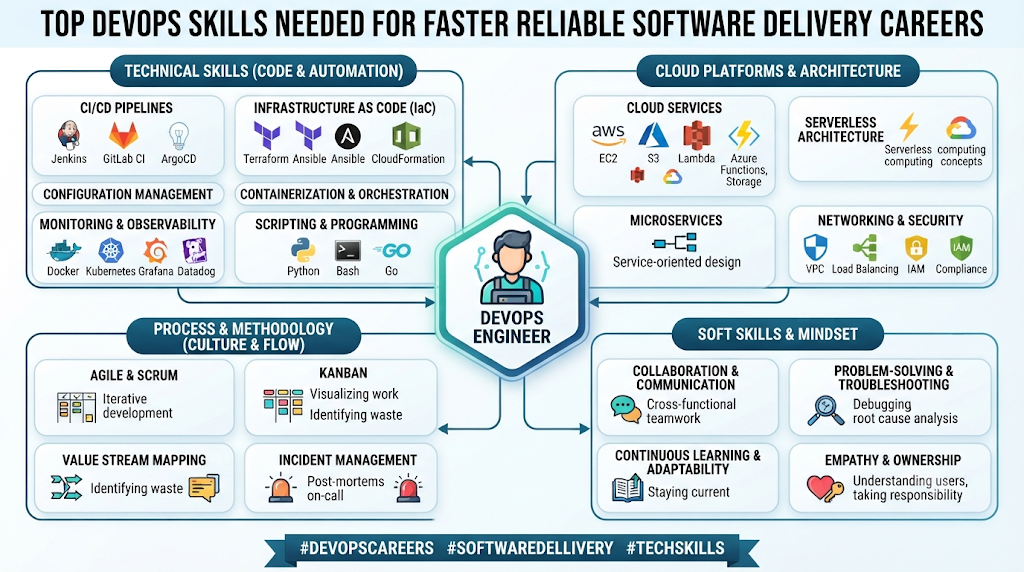
Section 7: Essential DevOps Engineer Skills
Developing balanced DevOps Engineer Skills requires combining strong technical capabilities with core communication and problem-solving skills.
                  ┌────────────────────────────────────────┐
                  │      ESSENTIAL DEVOPS SKILLSET         │
                  └───────────────────┬────────────────────┘
                                      │
            ┌─────────────────────────┴─────────────────────────┐
            ▼                                                   ▼
┌───────────────────────┐                           ┌───────────────────────┐
│   TECHNICAL PILLARS   │                           │     HUMAN PILLARS     │
├───────────────────────┤                           ├───────────────────────┤
│ • Linux Administration│                           │ • Clear Tech Writing  │
│ • Git Infrastructure  │                           │ • cross-Team Empathy  │
│ • Containerization    │                           │ • Root Cause Analysis │
│ • Cloud Architecture  │                           │ • Incident Ownership  │
│ • Infrastructure-Code │                           │ • Blameless Post-Mortem│
└───────────────────────┘                           └───────────────────────┘
Technical Skills
- System Environments: Expert manipulation of Linux filesystems, networking configurations, and shell scripts.
- Version Pipelines: Implementing clear branching strategies that protect production environments while minimizing deployment friction.
- Cloud Orchestration: Deep understanding of multi-region cloud networks, IAM policy models, security layers, and container configurations.
- Automated Infrastructure: Writing declarative code blocks to scale enterprise components rapidly while ensuring drift detection is operational.
Soft Skills
- Empathetic Communication: Explaining complex architectural updates or post-mortem incident mechanics cleanly to cross-functional business stakeholders.
- Collaborative Mindset: Breaking down old rivalries between software developers and operations personnel by championing shared goals.
- Root Cause Problem Solving: Resisting temporary fixes during production failures; instead, investigating underlying systematic causes to prevent reoccurrence.
Section 8: DevOps Projects for Hands-On Learning
Building DevOps Projects solidifies theoretical concepts into functional expertise. Use these distinct tiers to structure your personal lab work.
Beginner Level: Static Web Architecture
- Objective: Host a secure, automated static portfolio website.
- Outcome: Deploy a frontend layout to Google Cloud Storage or AWS S3, configure CDN distribution with HTTPS certificates, and automate content updates via Git pushes.
Intermediate Level: Containerized App on Managed Kubernetes
- Objective: Deploy a scalable, multi-tier application.
- Outcome: Package an application and database into custom Docker containers, write Kubernetes manifests for deployments, services, and secrets, and provision a managed cloud cluster using Terraform.
Advanced Level: GitOps-Driven Microservices Stack
- Objective: Implement an automated, self-healing GitOps delivery workflow.
- Outcome: Deploy microservices applications using ArgoCD or Flux on a Kubernetes cluster. Integrate comprehensive observability tools, automate Canary deployment profiles, and implement real-world chaos experiments to prove system resilience.
Section 9: Common DevOps Interview Questions
Reviewing practical DevOps Interview Questions prepares you to explain technical architectural concepts clearly during hiring assessments.
Q1: What is the main difference between Continuous Delivery and Continuous Deployment?
In Continuous Delivery, every code change passes automated tests and is built into a release artifact, but manually triggering the deployment to production requires human approval. In Continuous Deployment, the entire pipeline is fully automated; passing tests automatically trigger production deployments without human intervention.
Q2: How does a container differ from a virtual machine?
Virtual machines include a full guest operating system running on top of a hypervisor, consuming significant system resources. Containers share the host system’s OS kernel, isolating application workloads at the process level, which makes them lightweight, fast to boot, and highly portable.
Q3: Explain the concept of Infrastructure as Code (IaC) and its primary benefit.
IaC manages and provisions cloud infrastructure through machine-readable definition files rather than manual point-and-click configuration. Its primary benefit is consistency, which eliminates configuration drift and allows environments to be versioned, audited, and rapidly duplicated.
Q4: What is configuration drift, and how do you prevent it?
Configuration drift happens when manual, ad-hoc changes are made directly to live production servers, causing them to fall out of sync with your declared infrastructure files. It is prevented by disabling manual server access and using tools like Terraform or Ansible to enforce the desired state automatically.
Q5: What is a blameless post-mortem?
A blameless post-mortem is an incident review process that assumes engineers act with good intentions based on the information they had at the time. Instead of pointing fingers at human error, it focuses on identifying systematic flaws, failure points, and missing safeguards in the platform architecture.
Q6: Why do we use blue-green deployment strategies?
Blue-green deployments minimize downtime and lower release risks by running two identical production environments. Blue runs live traffic while Green receives the new code update; once Green passes all automated health checks, traffic switches instantly over via load balancers. If errors occur, rolling back means routing traffic straight back to Blue.
Q7: Explain the concept of GitOps.
GitOps uses Git repositories as the absolute single source of truth for your infrastructure and application definitions. Automated operators running inside your clusters continuously compare the live state with the definitions stored in Git, automatically correcting any differences to match the code repository.
Q8: What role do namespaces play inside a Kubernetes cluster?
Namespaces act as virtual sub-clusters within a single physical Kubernetes cluster. They allow engineering teams to isolate workloads, manage resource quotas, partition network access controls, and organize dev, staging, and production environments on the same shared hardware.
Q9: What are canary releases?
Canary releases gradually roll out new application features to a small, isolated subset of live users before distributing the update across your entire production infrastructure. Teams monitor telemetry indicators during this test phase to ensure updates perform smoothly under real-world conditions.
Q10: How do you protect sensitive credentials within automated CI/CD configurations?
Sensitive items—such as passwords, API keys, and cloud credentials—should never be hardcoded into code repositories. Instead, manage them using secure encryption vaults or native platform secrets management solutions, injecting them dynamically into delivery runner contexts at runtime.
Q11: What is the purpose of an Ingress Controller in Kubernetes?
An Ingress Controller acts as an intelligent layer-7 reverse proxy and load balancer. It manages external incoming HTTP/HTTPS traffic into your cluster, routing requests directly to internal cluster services based on defined routing paths and hostnames.
Q12: Define Site Reliability Engineering (SRE).
SRE applies software engineering principles directly to infrastructure and operations challenges. It focuses on creating highly scalable, reliable software platforms by treating operational tasks as software problems that can be managed with automation.
Q13: What are Error Budgets?
An error budget represents the total acceptable amount of downtime or failed requests your application is allowed over a specific timeframe (e.g., 99.9% uptime permits a 0.1% error budget). Product teams spend this budget to push new features quickly; if the budget runs out, releases stop until stability is restored.
Q14: Explain the difference between mutable and immutable infrastructure.
Mutable infrastructure allows updates and configurations to be applied directly onto existing, active server instances over time, which can lead to configuration drift. Immutable infrastructure never modifies existing instances; instead, updates are deployed by provisioning entirely new servers from updated templates and decommissioning the old ones.
Q15: What is dark launching?
Dark launching deploys a new application feature directly into production environments while keeping it completely invisible to end-users via feature flags. Engineers use this method to run backend performance testing under real production loads before turning the feature on for the public.
Section 10: DevOps Engineer Salary Trends
Because specialized platform expertise remains in high demand, standard compensation structures for individuals with deep DevOps Engineer Salary metrics remain strong across global technology regions.
- Entry-Level Engineers: Focus on core script generation, repository management, and simple pipeline configurations. Base compensation levels vary between $85,000 and $110,000 annually.
- Mid-Level Engineers: Independently handle complex multi-cluster container distributions, write advanced IaC modules, and manage production issues. Compensation metrics scale between $115,000 and $155,000.
- Senior Infrastructure Architects: Own the end-to-end delivery framework, design overarching cloud architecture strategy, and lead architectural resilience programs. Senior compensation packages regularly exceed $165,000 to $220,000+.
Influencing Factors
An engineer's earning potential depends heavily on specific, in-demand technical competencies. Deep expertise in production-scale Kubernetes management and multi-cloud architecture design drastically increases market value. Demonstrating clear mastery of security automation integrations (DevSecOps) and advanced enterprise telemetry systems further boosts compensation, transforming engineers into highly sought-after platform assets.
Section 11: Understanding DORA Metrics
To objectively evaluate engineering efficiency, modern technology organizations rely heavily on frameworks developed by the DevOps Research and Assessment (DORA) group. These metrics give leadership a data-driven way to measure both delivery speed and operational stability.
┌────────────────────────────────────────────────────────────────────────┐
│                          THE DORA METRICS FRAMEWORK                    │
├───────────────────────────────────┬────────────────────────────────────┤
│           VELOCITY METRICS        │          STABILITY METRICS         │
├───────────────────────────────────┼────────────────────────────────────┤
│ • Deployment Frequency            │ • Change Failure Rate (CFR)        │
│   How often code reaches prod     │   % of releases causing issues     │
│                                   │                                    │
│ • Lead Time for Changes           │ • Mean Time to Recovery (MTTR)     │
│   Commit-to-production duration   │   Time required to fix outages     │
└───────────────────────────────────┴────────────────────────────────────┘- Deployment Frequency: Measures how often an organization successfully deploys code changes directly into production. High-performing teams strive for multiple on-demand deployments per day.
- Lead Time for Changes: The total time it takes for a code commit to pass through your delivery pipeline and run successfully in production.
- Change Failure Rate (CFR): The percentage of production deployments that result in degraded service quality, bugs, or outages that require immediate remediation or rollbacks.
- Mean Time to Recovery (MTTR): The average time required to fully restore services when a critical production outage or system degradation occurs.
Section 12: DORA Metrics Tools and Engineering Intelligence Platforms
To track these indicators accurately without creating manual reporting overhead for developers, teams implement dedicated DORA Metrics Tools.
- DevOpsIQ: An advanced engineering intelligence platform designed to automatically extract data from your entire ecosystem—including GitHub commits, Jira tickets, Jenkins pipelines, and production alerts—to deliver unified DORA metrics and performance analytics.
- Datadog & Prometheus: These platforms track real-time runtime environments and service health, but require custom data pipelines to correlate delivery velocities with infrastructure changes.
- GitHub Insights & GitLab Analytics: These tools offer great visibility into repository activities, pull request cycle times, and build run duration, but their scope is limited to the boundaries of their respective code platforms.
Section 13: How DevOpsIQ Improves Engineering Performance
DevOpsIQ bridges the gap between raw data collection and strategic execution by converting disparate events into clear, actionable engineering context.
Core Capability Set
- Unified Pulse Score: Combines deployment speed, platform stability, and code quality indicators into a single score that shows team delivery health at a glance.
- Automated MTTR Diagnostics: Correlates production system errors with recent code commits, pointing triage teams directly to the root cause of an issue to speed up recovery times.
- SLO & Error Budget Tracking: Continuously tracks service level compliance and provides early-warning notifications well before an error budget is depleted.
- Deployment Safety Analytics: Uses historical pipeline performance data to assess the risk level of upcoming deployment windows, making potential bottlenecks clear before they impact users.
Section 14: Why BestDevOps and DevOpsIQ Create a Complete DevOps Ecosystem
Building a high-performance engineering organization requires addressing two critical pillars: developing technical talent and measuring operational outcomes. Merging these workflows creates a powerful continuous improvement loop.
       ┌───────────────────────────────────────────────────────┐
       │                 THE CONTINUOUS LOOP                   │
       └───────────────────────────┬───────────────────────────┘
                                   │
              ┌────────────────────┴────────────────────┐
              ▼                                         ▼
┌───────────────────────────┐             ┌───────────────────────────┐
│     EDUCATIONAL LAYER     │             │     MEASUREMENT LAYER     │
│      (BestDevOps)         │             │        (DevOpsIQ)         │
├───────────────────────────┤             ├───────────────────────────┤
│ • Multi-Stage Roadmaps    │             │ • Automated DORA Scrape   │
│ • Certification Paths     │             │ • Real-time MTTR Tracking │
│ • Deep Tool Manuals       │────────────>│ • Error Budget Guardrails │
│ • Hands-on Project Labs   │             │ • Multi-System Insights   │
└───────────────────────────┘             └───────────────────────────┘
              ▲                                         │
              └─────────────────────────────────────────┘
                       Optimize Skills on Trends
Educational Value Meets Engineering Intelligence
| Feature | Traditional Learning Resources | BestDevOps | DevOpsIQ |
| Skill Construction | Static documentation sheets | Interactive tutorials and certification roadmaps | N/A (Focuses on operational telemetry) |
| Hands-On Context | Theoretical exercises | Real-world project frameworks and sample scripts | N/A (Focuses on live production analytics) |
| Engineering Metrics | Manual spreadsheets | N/A (Focuses on education) | Real-time DORA automation and Pulse tracking |
| System Visibility | No live tool connections | Conceptual architecture patterns | Deep integrations with Git, CI/CD, and monitoring |
By using BestDevOps to continuously sharpen engineering skills and adopting DevOpsIQ to measure delivery outcomes, organizations build a highly capable engineering culture rooted in clear, empirical data.
Section 15: Future of DevOps and Engineering Intelligence
As technology evolves, several key trends are reshaping how engineering teams build, deploy, and maintain software.
- AI-Assisted Operations: Machine learning models are moving beyond code generation. They are increasingly integrated into deployment guardrails and telemetry platforms to predict system anomalies and automatically orchestrate rollbacks before users experience an issue.
- The Rise of Platform Engineering: Organizations are moving away from forcing developers to manage complex infrastructure directly. Instead, dedicated platform teams build Internal Developer Platforms (IDPs) that offer self-service infrastructure templates, reducing cognitive load and speeding up development cycles.
- Data-Driven Engineering Leadership: Gut feelings are being replaced by data. Engineering leaders leverage comprehensive analytics platforms to spot process bottlenecks, evaluate delivery trends, and ensure development efforts map cleanly to business outcomes.
Conclusion
Mastering modern software delivery requires balancing human skill development with robust, data-driven engineering insights. Building high-performing engineering teams starts with establishing strong foundational knowledge. Platforms like BestDevOps provide the structured learning paths, tool comparisons, projects, and certification prep necessary to build modern infrastructure talent. However, technical expertise is only part of the equation. To truly scale delivery velocity, organizations must measure performance accurately using objective engineering metrics.
