DCP Certification by DevOpsSchool: Career Benefits & Roadmap
Introduction
The DevOps Certified Professional (DCP) is an industry-focused certification designed to validate practical DevOps skills across tools, automation, CI/CD, cloud, and modern infrastructure practices. Offered by DevOpsSchool, this certification targets professionals aiming to bridge development and operations efficiently.This certification emphasizes hands-on learning, real-world use cases, and toolchain integration rather than just theoretical knowledge.
What It Is
It is a practical, project-based certification that assesses your capability to implement DevOps workflows in real-world environments.
The program focuses on automation, CI/CD pipelines, containerization, and infrastructure as code.
Who Should Take It
- DevOps Engineers and aspiring professionals
- System Administrators transitioning to DevOps
- Cloud Engineers and Platform Engineers
- Software Developers working with CI/CD
- IT professionals aiming for automation and scalability skills
DevOps Certified Professional (DCP) Certification Overview
The DevOps Certified Professional (DCP) program is delivered via structured training modules and hosted on DevOpsSchool.
- Certification Levels: Primarily focused on intermediate to advanced-level professionals
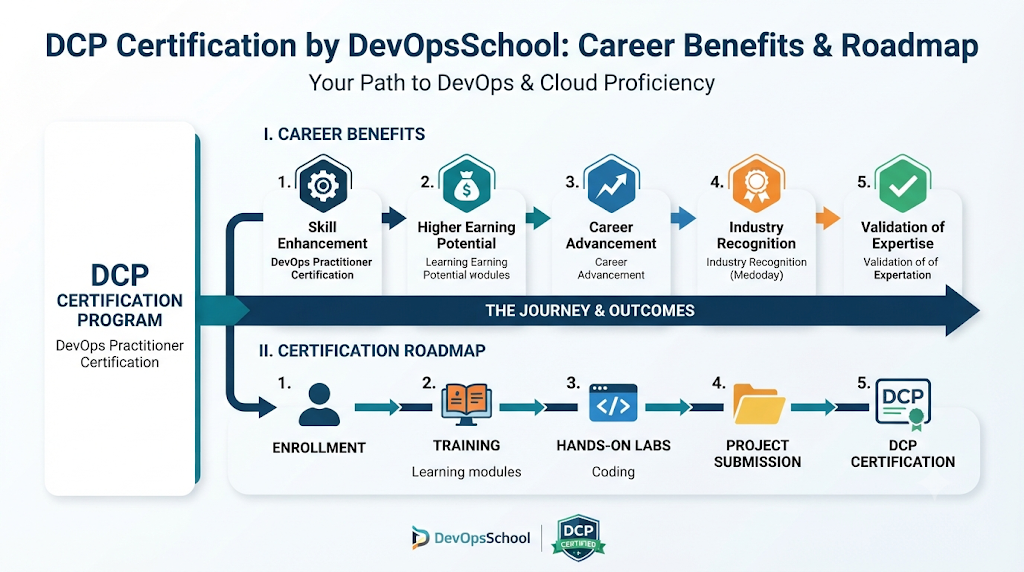
- Assessment Approach: Includes hands-on labs, real-time projects, and final evaluation
- Ownership: Managed and delivered by DevOpsSchool with industry-aligned curriculum
- Structure: Combines instructor-led sessions, assignments, case studies, and project work
Skills You’ll Gain
- CI/CD pipeline design and implementation
- Containerization using Docker
- Kubernetes orchestration
- Infrastructure as Code (Terraform, Ansible)
- Monitoring and logging (Prometheus, Grafana)
- Cloud deployment strategies (AWS/Azure/GCP basics)
- Version control and Git workflows
- Automation and scripting
Real-World Projects You Should Be Able to Do After It
- Build and deploy a CI/CD pipeline using Jenkins and Git
- Containerize applications and deploy using Docker & Kubernetes
- Automate infrastructure provisioning using Terraform
- Set up monitoring dashboards using Prometheus and Grafana
- Implement blue-green or rolling deployments
- Configure logging and alerting systems
Common Mistakes
- Skipping hands-on labs and focusing only on theory
- Ignoring version control best practices
- Not understanding pipeline failure debugging
- Overlooking monitoring and observability setup
- Learning tools without understanding DevOps principles
Best Next Certification After This
- Kubernetes Certification (CKA/CKAD)
- AWS DevOps Engineer Professional
- Certified Kubernetes Security Specialist (CKS)
Complete Certification Table
| Track | Level | Who it’s for | Prerequisites | Skills Covered | Recommended Order | |
|---|---|---|---|---|---|---|
| DevOps | Intermediate | DevOps Engineers | Basic Linux, Git | CI/CD, Docker, Kubernetes | 1 | |
| DevSecOps | Intermediate | Security + DevOps professionals | DevOps basics | Security automation, SAST/DAST | 2 | |
| SRE | Advanced | Reliability Engineers | Monitoring basics | SLIs, SLOs, Observability | 3 | |
| AIOps/MLOps | Advanced | AI/ML Engineers | Python, ML basics | ML pipelines, automation | 4 | |
| DataOps | Intermediate | Data Engineers | Data pipelines | Data workflow automation | 5 | |
| FinOps | Intermediate | Cloud cost engineers | Cloud basics | Cost optimization | 6 |
Choose Your Path
- DevOps Path: DCP → Kubernetes → Cloud DevOps
- DevSecOps Path: DCP → DevSecOps Certification → Security Specialization
- SRE Path: DCP → Monitoring → SRE Certification
- AIOps/MLOps Path: DCP → ML pipelines → AIOps Certification
- DataOps Path: DCP → Data pipelines → DataOps Certification
- FinOps Path: DCP → Cloud billing → FinOps Certification
Role → Recommended Certifications
| Role | Recommended Certifications |
|---|---|
| DevOps Engineer | DCP, Kubernetes, AWS DevOps |
| SRE | DCP, SRE Certification, Observability |
| Platform Engineer | DCP, Terraform, Kubernetes |
| Cloud Engineer | DCP, AWS/Azure/GCP |
| Security Engineer | DCP, DevSecOps |
| Data Engineer | DCP, DataOps |
| FinOps Practitioner | DCP, FinOps |
| Engineering Manager | DCP, DevOps Leadership |
Top Institutes for Training
Leading institutions like DevOpsSchool, Cotocus, ScmGalaxy, BestDevOps, DevSecOpsSchool, SRESchool, AIOpsSchool, DataOpsSchool, and FinOpsSchool provide structured training programs for DevOps Certified Professional (DCP). These platforms offer hands-on labs, real-time project exposure, and mentorship from industry experts. Their courses are designed with practical implementation in mind, helping learners gain job-ready skills. Many of these institutes also provide career guidance, certification preparation, and enterprise-level use case training, making them suitable for both beginners and experienced professionals.
Next Certifications to Take
- Same Track: Advanced Kubernetes (CKA/CKAD)
- Cross-Track: DevSecOps Certification
- Leadership: DevOps Architect / Engineering Manager Certification
FAQs
- What is DevOps Certified Professional (DCP)?
It is a certification validating practical DevOps skills including CI/CD, containers, and automation. - Who provides the DCP certification?
DevOpsSchool offers and manages the certification. - Is DCP beginner-friendly?
It is best suited for intermediate learners with basic DevOps knowledge. - What tools are covered?
Docker, Kubernetes, Jenkins, Git, Terraform, and monitoring tools. - Is there a hands-on project?
Yes, real-world projects are a core part of the certification. - How long does it take to complete?
Typically a few weeks depending on learning pace. - Is it recognized in the industry?
Yes, especially in practical DevOps skill validation contexts. - Does it include cloud training?
Yes, basic AWS/Azure/GCP integration is covered. - What is the exam format?
Practical assignments and evaluation-based certification. - What job roles can I target after DCP?
DevOps Engineer, SRE, Cloud Engineer, and Platform Engineer.
Why Choose DevOpsSchool?
DevOpsSchool stands out due to its strong focus on hands-on learning, real-world project implementation, and expert mentorship. Unlike purely theoretical programs, it emphasizes practical DevOps workflows, making learners industry-ready. The curriculum is continuously updated to match current DevOps trends, tools, and enterprise requirements. Additionally, learners benefit from structured guidance, community support, and career-oriented training paths across DevOps, SRE, DevSecOps, and emerging domains.
Conclusion
The DevOps Certified Professional (DCP) certification is a solid choice for professionals aiming to build practical DevOps expertise. With its focus on real-world tools, automation, and deployment strategies, it prepares you for modern cloud-native environments. Whether you are transitioning into DevOps or advancing your career, DCP provides a strong foundation and opens pathways into specialized domains like Kubernetes, DevSecOps, and SRE.
