Essential AWS Certified DevOps Engineer – Professional Exam Readiness Guide
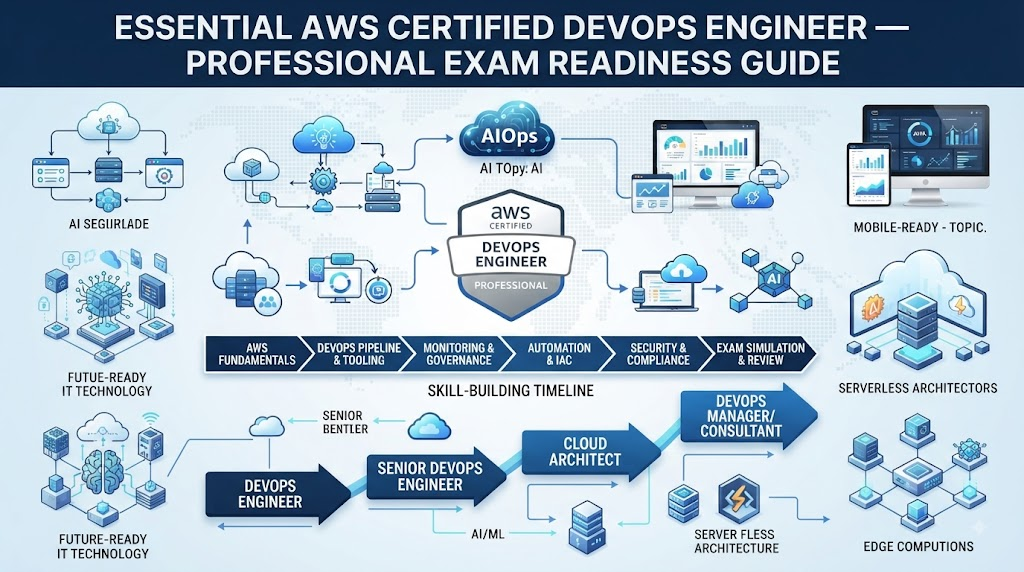
Introduction
Cloud environments are becoming increasingly automated, and organizations need engineers who can manage software delivery, infrastructure, security, and operations together. AWS provides a broad ecosystem that supports these requirements, making AWS DevOps skills valuable across modern technology teams.The AWS Certified DevOps Engineer – Professional certification is intended for experienced professionals who want to validate their ability to design, implement, and manage DevOps practices on AWS. The certification goes beyond basic cloud knowledge and focuses on automation, deployment, monitoring, reliability, security, and operational response.
What Is AWS Certified DevOps Engineer – Professional?
AWS Certified DevOps Engineer – Professional is a Professional-level certification that validates advanced knowledge of provisioning, operating, and managing distributed application systems on AWS. The current exam code is DOP-C02.The certification is particularly relevant to engineers who work with:
- CI/CD pipelines
- Infrastructure automation
- Cloud operations
- Application deployments
- Monitoring and logging
- Security controls
- Incident response
- High availability
- Infrastructure as Code
The main objective is not simply to test whether a candidate remembers AWS service descriptions. Instead, candidates need to understand how AWS technologies can be combined to build reliable and automated delivery environments.
Understanding AWS DevOps
AWS DevOps brings software development and operations practices together with AWS cloud capabilities.Without automation, teams may have to manually provision servers, configure applications, test releases, deploy software, and monitor production systems. As the number of applications and environments grows, this approach becomes difficult to manage.DevOps introduces automation and repeatable processes.A basic AWS DevOps lifecycle can be represented as:Develop → Build → Test → Release → Deploy → Monitor → ImproveInfrastructure can also be defined through code, while automated pipelines can handle repetitive software delivery tasks.The overall objective is to make application delivery more consistent while maintaining security, reliability, and operational visibility.
Why AWS DevOps Knowledge Matters
Organizations want to release new features quickly, but speed alone is not enough. Applications must also remain stable, secure, and available.AWS DevOps practices can help teams:
- Automate repetitive operational work.
- Improve deployment consistency.
- Reduce manual configuration.
- Release applications more frequently.
- Monitor infrastructure and applications.
- Detect failures earlier.
- Scale cloud resources.
- Integrate security into delivery workflows.
- Improve recovery processes.
The strongest AWS DevOps professionals understand the relationship between these areas rather than treating each AWS service as a separate technology.
AWS Certified DevOps Engineer – Professional Exam Overview
According to current AWS information, the DOP-C02 exam has the following structure:
| Exam Detail | Current Information |
|---|---|
| Certification level | Professional |
| Exam code | DOP-C02 |
| Exam duration | 180 minutes |
| Number of questions | 75 |
| Question types | Multiple choice and multiple response |
| Exam price | USD $300 |
| Delivery | Testing center or online proctored |
| Languages | English, Japanese, Korean, Simplified Chinese |
| Certification validity | 3 years |
AWS currently lists the Professional certification exam at $300 USD. Pricing can vary by region, taxes, and purchasing method.The current DOP-C02 exam guide specifies a 750/1000 scaled passing score. AWS uses compensatory scoring, so candidates are evaluated on their overall exam performance rather than needing to pass every domain independently.The certification remains valid for three years, after which candidates need to follow AWS recertification requirements to maintain the credential.
Who Should Consider This Certification?
The certification is designed primarily for professionals who already work with AWS and DevOps technologies.It can be relevant to:
- DevOps Engineers
- Cloud Engineers
- AWS Engineers
- Platform Engineers
- Site Reliability Engineers
- Cloud Architects
- System Administrators
- Software Developers working with AWS
- DevSecOps Engineers
- Cloud Consultants
AWS recommends at least two years of experience provisioning, operating, and managing AWS environments. It also recommends experience with software development lifecycle processes and programming or scripting.Professionals who are completely new to AWS may find Associate-level learning more appropriate before moving toward this Professional-level certification.
Prerequisites and Recommended Knowledge
Before preparing for DOP-C02, candidates should be comfortable with several technical foundations.Important areas include:
- AWS fundamentals
- Linux
- Networking
- IAM
- Git
- CI/CD
- Infrastructure as Code
- Containers
- Cloud monitoring
- Security
- Scripting
- Troubleshooting
For example, it is useful to know what AWS CodeBuild does. However, professional-level knowledge means understanding how CodeBuild connects to a pipeline, how permissions are managed, where artifacts are stored, and what happens when the build process fails.
Skills You Can Build Through Preparation
Preparation for the certification can improve several practical areas.
CI/CD Engineering
You learn how to automate source-code builds, testing, artifact creation, and application deployment.
Infrastructure Automation
You gain experience with Infrastructure as Code and repeatable cloud provisioning.
Monitoring
You develop an understanding of metrics, logs, alarms, dashboards, and application visibility.
Security
You strengthen your understanding of IAM, encryption, secrets, auditing, and security automation.
Reliability
You learn how cloud systems can be designed for availability, failure recovery, and resilience.
Troubleshooting
Scenario-based study helps you reason about deployment failures, infrastructure issues, and operational incidents.
DOP-C02 Exam Domains
The current AWS Certified DevOps Engineer – Professional exam contains six domains.
| Exam Domain | Weight |
| SDLC Automation | 22% |
| Configuration Management and IaC | 17% |
| Resilient Cloud Solutions | 15% |
| Monitoring and Logging | 15% |
| Incident and Event Response | 14% |
| Security and Compliance | 17% |
SDLC Automation
At 22%, SDLC Automation represents the largest portion of the exam.Candidates should understand automated software delivery, including:
- Source control
- Build processes
- Automated testing
- Artifact management
- Deployment pipelines
- Deployment strategies
- Release validation
- Rollbacks
AWS services such as CodePipeline, CodeBuild, CodeDeploy, and related services should be understood as parts of complete delivery workflows.
Configuration Management and Infrastructure as Code
This domain focuses on automated infrastructure and configuration.Important concepts include:
- CloudFormation
- AWS CDK
- Reusable templates
- Configuration management
- Infrastructure lifecycle
- Multi-account environments
- Automated provisioning
- Configuration drift
The goal is to understand how infrastructure can be created and managed consistently rather than manually.
Resilient Cloud Solutions
Modern applications need to tolerate failures.Study:
- High availability
- Fault tolerance
- Multi-AZ architecture
- Multi-Region designs
- Replication
- Failover
- Disaster recovery
- Recovery objectives
Scenario questions may require you to select an architecture that provides the required availability while considering operational complexity and cost.
Monitoring and Logging
A DevOps environment needs reliable visibility.Important concepts include:
- Metrics
- Logs
- Alarms
- Dashboards
- Application monitoring
- Infrastructure monitoring
- Log analysis
- Distributed tracing
- Operational visibility
Amazon CloudWatch is an important part of this area, but preparation should focus on using monitoring information to identify and resolve real problems.
Incident and Event Response
Production environments inevitably experience failures.This domain focuses on how engineers detect events, investigate problems, automate responses, modify configurations, and restore services.For example, an event could trigger an automated Lambda function or Systems Manager workflow to perform a predefined remediation task.
Security and Compliance
Security needs to be integrated into the entire DevOps process.Important areas include:
- IAM
- Least privilege
- Encryption
- Secrets management
- Security monitoring
- Compliance
- Auditing
- Automated security controls
- Data protection
Candidates should understand how security can be implemented without creating unnecessary manual steps in the delivery lifecycle.
AWS Services to Study
A useful way to prepare is to organize AWS services according to their role.CI/CD: CodePipeline, CodeBuild, CodeDeployInfrastructure as Code: CloudFormation, CDKCompute: EC2, Lambda, Auto ScalingContainers: ECS, EKS, ECRStorage: S3Databases: RDS, DynamoDBNetworking: VPC, Route 53, Elastic Load Balancing, CloudFrontSecurity: IAM, KMS, Secrets Manager, AWS Config, Security HubOperations: Systems ManagerMonitoring: CloudWatch, CloudTrail, X-RayAutomation: Lambda, EventBridge, Systems Manager AutomationDo not rely on an old service list. AWS can change certification scope, so the latest official exam guide should be your final reference.
CI/CD Workflows on AWS
A CI/CD pipeline can automate the movement of application code from development to production.A simplified workflow is:Source → Build → Test → Artifact → Deploy → Validate → MonitorFor example, a source-code change can trigger a pipeline. The build stage compiles the application and executes tests. A successful build produces an artifact that can be stored and deployed.The deployment stage can then release the application to a test or production environment.For professional-level preparation, focus on what happens when something goes wrong.Consider a situation where the application builds successfully but the production deployment causes increased error rates. A strong DevOps engineer should understand how health checks, monitoring, deployment strategies, and rollback mechanisms can work together.
Infrastructure as Code and Automation
Infrastructure as Code allows cloud infrastructure to be managed similarly to application code.With CloudFormation, infrastructure resources can be defined using templates and deployed consistently. AWS CDK provides another approach by allowing infrastructure to be defined using supported programming languages.IaC offers several advantages:
- Repeatable deployments
- Version control
- Consistent environments
- Automated provisioning
- Easier change management
- Reduced manual configuration
Candidates should also understand configuration drift and how automated infrastructure management can help keep environments aligned with their intended configuration.
Monitoring, Logging and Observability
Monitoring should provide enough information to understand the health of an environment.Metrics can reveal performance trends, logs can show detailed application or infrastructure events, and alarms can identify predefined conditions.Dashboards help teams view important signals in one place, while tracing can help investigate requests that travel through multiple services.The goal is not simply to collect data. Good observability helps engineers answer:What is happening? When did it start? What changed? What caused it?
Security and DevSecOps
DevSecOps integrates security throughout software delivery.A secure AWS DevOps workflow can include:
- Least-privilege IAM permissions
- Managed secrets
- Encryption
- Security testing
- Vulnerability checks
- Secure artifact handling
- Logging and auditing
- Compliance validation
For example, a pipeline can prevent deployment when a required security check fails instead of discovering the issue after the application reaches production.
Understanding Deployment Strategies
Choosing a deployment method depends on application requirements.
Rolling Deployment
New versions are introduced gradually across existing resources. This can reduce disruption but requires careful health and capacity management.
Blue-Green Deployment
Two environments are maintained, and traffic can be shifted from the existing version to the new version. This approach can simplify rollback.
Canary Deployment
The new version initially receives a small amount of traffic. If the application remains healthy, the rollout can continue.
Immutable Deployment
Instead of modifying existing production infrastructure, new resources are created for the new release.
Automated Rollback
The system automatically returns to a known-good version when health checks or monitoring conditions indicate a failed deployment.Professional-level DevOps knowledge means understanding the trade-offs between these strategies.
Example of an AWS DevOps Workflow
Consider a team developing an online application.A developer pushes code to the source repository. This change triggers a pipeline.The pipeline builds the application, executes automated tests, performs required validation, and creates a deployable artifact.Infrastructure is maintained through Infrastructure as Code. Once the application passes validation, it is deployed using an appropriate strategy.CloudWatch monitors important application and infrastructure signals.Suppose the new release causes an unexpected increase in errors. Monitoring detects the problem and triggers an alert. Engineers investigate logs and metrics and determine whether the release should be rolled back.After recovery, the team can improve automated tests, monitoring rules, or deployment controls to reduce the possibility of repeating the same incident.This workflow demonstrates why AWS DevOps certification preparation should focus on complete systems rather than isolated AWS services.
Hands-on Projects for DOP-C02 Preparation
Practical projects can help turn theoretical knowledge into usable skills.Try projects such as:
- Build a CI/CD pipeline for a sample web application.
- Provision the application environment using CloudFormation.
- Deploy a containerized application using ECS.
- Create CloudWatch dashboards and alarms.
- Implement a controlled blue-green deployment.
- Configure automated rollback.
- Add security checks to a delivery pipeline.
- Create an event-driven remediation workflow.
A useful exercise is to intentionally break something in your lab environment and then troubleshoot it using logs, metrics, events, and AWS documentation.
Benefits of AWS Certified DevOps Engineer – Professional
The certification can demonstrate advanced knowledge of AWS DevOps practices and provide a structured learning target.Possible benefits include:
- Validating technical knowledge
- Improving AWS DevOps understanding
- Strengthening professional credibility
- Supporting career development
- Building stronger automation skills
- Improving understanding of cloud operations
It is important to keep expectations realistic. Certification does not automatically result in a job, promotion, or higher salary. Practical experience continues to matter.
AWS DevOps Engineer – Professional Preparation Roadmap
Step 1: Evaluate Your Current Skills
Check your understanding of AWS, networking, Linux, security, CI/CD, and cloud operations.
Step 2: Read the Current Exam Guide
Understand the domains, objectives, and expected knowledge.
Step 3: Prioritize the Domains
Give additional study time to SDLC Automation because it has the highest weighting.
Step 4: Learn Services Through Projects
Use AWS services in practical environments instead of studying them only from notes.
Step 5: Practice Troubleshooting
Create failure scenarios involving deployments, permissions, monitoring, networking, and infrastructure.
Step 6: Work Through Scenario Questions
Focus on the reasoning behind each answer.
Step 7: Identify Weak Areas
Track incorrect practice questions and revisit the related AWS documentation.
Step 8: Use Official Preparation Resources
AWS provides resources through AWS Skill Builder, Builder Labs, practice questions, practice exams, and other learning experiences.
Step 9: Perform a Final Review
Before taking the exam, review deployment strategies, IaC, security, monitoring, resilience, automation, and incident response.
Common Mistakes Candidates Make
Memorizing Questions
Question banks can help with practice, but memorization does not develop the reasoning needed for unfamiliar scenarios.
Avoiding Hands-on Practice
AWS DevOps is highly practical. Using the services yourself can reveal details that are easy to miss in theory.
Studying Services Independently
Learn how services interact. A professional-level question may require several AWS services to work together.
Ignoring Security
Security is not a separate afterthought. IAM, encryption, access control, and auditing can influence many architecture decisions.
Neglecting Troubleshooting
DevOps engineers spend significant time investigating failures. Make troubleshooting part of your preparation.
Using Old Study Material
Always compare your study material with the current AWS exam guide.
Career Opportunities
The skills covered by the certification can support multiple technical career paths.
AWS DevOps Engineer
Focuses on automation, CI/CD, cloud infrastructure, and operational processes.
Cloud Engineer
Designs, deploys, and manages cloud infrastructure.
Platform Engineer
Builds internal platforms and automation that make application delivery easier for development teams.
Site Reliability Engineer
Concentrates on system reliability, observability, automation, and incident management.
DevSecOps Engineer
Integrates security practices into development and operations.
Cloud Architect
Designs broader cloud solutions and helps organizations make architectural decisions.The certification can complement these roles, but career progression depends on practical experience, technical skills, communication, and project results.
Salary and Professional Growth
There is no fixed salary attached to this certification.Compensation can vary based on:
- Experience
- Location
- Organization
- Industry
- Role
- Technical specialization
- Cloud expertise
- Additional skills
Professionals who combine AWS DevOps knowledge with Kubernetes, security, Infrastructure as Code, Python, observability, SRE, or architecture skills may be able to pursue a wider range of roles.Salary research should always use current information from reliable sources because compensation changes across markets and over time.
AWS DevOps Professional Compared With Other Certifications
| Certification | Main Focus | Level | Suitable For |
| AWS Certified DevOps Engineer – Professional | DevOps, automation, delivery and operations | Professional | Experienced DevOps professionals |
| AWS Certified Solutions Architect – Professional | Advanced cloud architecture | Professional | Senior cloud architects |
| AWS Certified Developer – Associate | AWS application development | Associate | Developers |
| AWS Certified CloudOps Engineer – Associate | AWS operations and cloud management | Associate | Cloud operations professionals |
If your primary goal is advanced AWS software delivery, automation, operations, and DevOps engineering, the DevOps Engineer – Professional certification is the most directly aligned option.
The Future of AWS DevOps
DevOps continues to expand as cloud environments become more automated.Several areas are becoming increasingly important:
- AI-assisted development and operations
- Platform Engineering
- DevSecOps
- GitOps
- Kubernetes
- Infrastructure automation
- Cloud-native development
- Advanced observability
- Automated remediation
- Serverless architectures
AI and automation are increasingly being used to identify operational problems, recommend actions, improve developer workflows, and reduce repetitive work.This means future DevOps professionals will need more than pipeline knowledge. They will increasingly need to understand automation, platform design, reliability, security, and intelligent operational tooling.
What to Learn After Certification
Your next certification or skill area should match your career goals.If you want to move toward architecture, focus on advanced AWS architecture and distributed systems.If security interests you, explore cloud security and DevSecOps.For reliability-focused careers, build deeper SRE, observability, incident management, and disaster recovery knowledge.For Platform Engineering, learn Kubernetes, GitOps, internal developer platforms, and infrastructure automation.You can also expand into multi-cloud environments if your professional role requires broader cloud knowledge.
Key Takeaways
- AWS Certified DevOps Engineer – Professional is an advanced AWS certification.
- The current exam code is DOP-C02.
- The exam contains 75 questions and provides 180 minutes.
- AWS recommends two or more years of relevant AWS experience.
- The exam has six major domains.
- SDLC Automation has the highest weighting.
- Infrastructure as Code, resilience, monitoring, security, and incident response are major preparation areas.
- Practical AWS projects can significantly improve understanding.
- Scenario-based reasoning is more valuable than simple memorization.
- Certification should complement, not replace, real-world experience.
FAQs
1. What does AWS Certified DevOps Engineer – Professional validate?
It validates advanced technical knowledge related to provisioning, operating, and managing distributed systems and DevOps workflows on AWS.
2. Is DOP-C02 suitable for AWS beginners?
It is designed for experienced professionals. Beginners should generally build AWS and DevOps fundamentals before attempting a Professional-level certification.
3. How much AWS experience is recommended?
AWS recommends two or more years of experience provisioning, operating, and managing AWS environments.
4. How many questions are on the DOP-C02 exam?
The current exam contains 75 questions.
5. How much time is available during the exam?
Candidates receive 180 minutes to complete the examination.
6. What is the DOP-C02 passing score?
The current AWS exam guide lists a passing scaled score of 750 out of 1,000.
7. What should I study first for AWS DevOps Professional?
Start by reviewing the official exam domains. SDLC Automation is the largest domain, followed by Configuration Management and IaC and Security and Compliance.
8. Do I need to know CloudFormation?
Yes, Infrastructure as Code is an important part of the certification objectives, and CloudFormation is a key AWS technology to understand.
9. Should I practice CI/CD before taking the exam?
Yes. Building a real CI/CD workflow can make pipeline, deployment, artifact, testing, and rollback concepts much easier to understand.
10. Is security included in the DevOps Professional exam?
Yes. Security and Compliance is one of the six current exam domains.
11. Does AWS DevOps Professional require programming?
AWS recommends programming or scripting experience for the target candidate profile. Strong scripting skills can also be useful for automation and troubleshooting.
12. How long does the certification remain valid?
The AWS Certified DevOps Engineer – Professional certification is valid for three years.
13. Where can I find official study resources?
AWS Skill Builder, the official exam guide, AWS documentation, Builder Labs, practice questions, and practice exams are useful starting points.
14. Will the certification guarantee a higher salary?
No. Salary depends on experience, location, employer, role, and technical capabilities. Certification is only one factor.
15. What should I learn after AWS DevOps Professional?
Depending on your goals, consider AWS architecture, cloud security, DevSecOps, Kubernetes, SRE, Platform Engineering, GitOps, or advanced infrastructure automation.
Conclusion
AWS Certified DevOps Engineer – Professional provides a structured way for experienced professionals to validate advanced AWS DevOps capabilities. The DOP-C02 exam covers much more than CI/CD, including Infrastructure as Code, resilience, monitoring, incident response, security, and operational automation.
