Best Cosmetic Hospitals in the World for Safe Treatment Research
Introduction
Finding the best cosmetic hospitals in the world is not simply about locating the lowest price or the most attractive treatment package. Patients must compare hospital standards, surgeon qualifications, procedure experience, anaesthesia support, infection-control practices, emergency facilities, recovery arrangements, and long-term follow-up care.Cosmetic surgery has become increasingly international.
Why This Topic Matters
The global growth of cosmetic surgery has made information widely available, but not every online claim is reliable. Promotional packages may focus heavily on price while providing limited details about the medical team, surgical facility, anaesthesia provider, emergency arrangements, or complication policy.This topic matters for several reasons:
- Cosmetic surgery is real surgery and carries possible risks.
- Medical and licensing standards differ between countries.
- A low initial quotation may exclude important expenses.
- Patients may find it difficult to obtain follow-up treatment after returning home.
- Surgeon titles and cosmetic credentials do not always mean the same thing internationally.
- Travel soon after surgery can create additional health concerns.
- Results depend on individual anatomy, health, surgical technique, healing, and aftercare.
The CDC advises medical travellers to research providers, understand possible complications, arrange follow-up care, and consider the financial cost of emergency treatment after returning home. It also notes that surgery and prolonged travel can both contribute to blood-clot risk.Informed decision-making therefore involves more than comparing photographs and package prices. It requires examining the patient, procedure, surgeon, and surgical setting together.
Global Cosmetic Surgery Overview
Demand for surgical and nonsurgical cosmetic procedures has expanded across North America, Latin America, Europe, the Middle East, and Asia. Patients now travel internationally for facial surgery, breast procedures, body contouring, hair restoration, skin treatments, and reconstructive care.Several developments are shaping the industry:
Greater Access to International Treatment
Video consultations, digital medical records, multilingual patient departments, and online hospital directories have made it easier to contact overseas providers. Many large hospitals now have dedicated international patient teams that assist with records, quotations, accommodation, transportation, and interpretation.
More Specialised Destinations
Different destinations are known for different areas of cosmetic treatment. Turkey has developed a large hair-restoration and rhinoplasty market. South Korea is widely associated with facial procedures. Brazil has a long-established body-contouring sector, while Thailand, India, and Mexico offer broad medical-tourism infrastructure.These reputations should be treated as starting points for research rather than proof that every provider in that country offers the same standard.
Developments in Surgical Technology
Modern hospitals may use improved imaging, surgical planning, anaesthesia monitoring, minimally invasive equipment, advanced implant options, and specialised body-contouring technologies. Technology is helpful only when it is used by properly trained professionals in an appropriate surgical setting.
More Informed Patient Expectations
Patients increasingly ask about natural-looking outcomes, scar placement, revision policies, implant safety, recovery duration, and long-term maintenance. Responsible surgeons should explain both potential improvements and limitations without guaranteeing a particular outcome.
Popular Cosmetic Procedures
Rhinoplasty
Rhinoplasty changes the structure or appearance of the nose and may sometimes address breathing concerns. It can involve the nasal tip, bridge, nostrils, bone, cartilage, or internal structures.Early swelling and bruising may improve over several weeks, but the final nasal contour can continue refining for up to a year. Individual recovery depends on the technique and extent of surgery.
Liposuction
Liposuction removes selected fat deposits to improve body contour. It is not a general weight-loss treatment and does not necessarily correct loose skin.The size and number of treatment areas affect the surgical plan and recovery. Patients may experience swelling, bruising, soreness, and temporary activity restrictions. ASPS recovery information indicates that many patients begin feeling better during weeks two and three, while swelling may continue improving for six weeks or longer.
Breast Augmentation
Breast augmentation uses implants or fat transfer to change breast volume and shape. Implant type, implant placement, incision location, existing breast tissue, and patient expectations must be discussed during consultation.Pain may reduce during the first several days, while soreness and swelling can continue for several weeks. Exercise and heavier activity should only be resumed according to the treating surgeon’s instructions.
Tummy Tuck
A tummy tuck, or abdominoplasty, removes excess abdominal skin and may repair separated or weakened abdominal muscles. It is a more extensive operation than liposuction and normally requires a longer recovery plan.Patients may need compression garments, temporary drains, help with daily activities, and restrictions on lifting and exercise. Recovery can take several weeks, while swelling and scars may continue changing for months.
Hair Transplant
Hair transplantation relocates suitable hair follicles from a donor area to areas with thinning or hair loss. Common approaches include follicular unit extraction and follicular unit transplantation.Initial healing may occur within days or weeks, but visible hair growth develops gradually over several months. Pricing often depends on the number of grafts, technique, medical-team involvement, and whether technicians or physicians perform key stages.
Facelift
A facelift is intended to address loose facial and neck tissue. Different techniques may focus on the skin, deeper facial layers, neck, or selected areas. Swelling, bruising, scars, and temporary changes in sensation should be discussed before treatment.
Eyelid Surgery
Eyelid surgery may remove or reposition skin, fat, and tissue around the upper or lower eyelids. Patients should understand that cosmetic eyelid surgery and medically necessary eyelid treatment are evaluated differently.
Body Contouring
Body contouring can include arm lifts, thigh lifts, lower body lifts, fat removal, and skin-removal surgery. These procedures may be considered after major weight loss, pregnancy, ageing, or changes in body shape. Larger operations can require longer recovery and greater medical support.No cosmetic procedure can guarantee symmetry, permanent satisfaction, or an exact visual result.
Best Countries for Plastic Surgery
The best countries for plastic surgery depend on the required procedure, budget, travel distance, language, surgeon availability, regulation, facility standards, and follow-up requirements.
Best Countries for Plastic Surgery Comparison
| Country | Popular Procedures | Cost Level | International Patient Support |
| Turkey | Hair transplant, rhinoplasty, breast surgery, liposuction | Low to moderate | Extensive package-based services in major cities |
| South Korea | Rhinoplasty, eyelid surgery, facial contouring, facelift | Moderate to high | Strong support in leading Seoul hospitals and clinics |
| Thailand | Breast surgery, rhinoplasty, body contouring, facelift | Moderate | Established international departments and interpreters |
| India | Hair restoration, rhinoplasty, liposuction, tummy tuck | Low to moderate | Large hospital networks and English-speaking coordinators |
| Mexico | Tummy tuck, breast augmentation, liposuction, rhinoplasty | Low to moderate | Strong services in border cities and tourism centres |
| Brazil | Liposuction, breast surgery, tummy tuck, body contouring | Moderate | Experienced cosmetic sector in major cities |
| United States | Broad range of complex and revision procedures | High | Strong specialist networks and domestic follow-up access |
| Germany | Facial surgery, breast surgery, reconstructive procedures | High | Structured healthcare systems and multilingual private care |
| UAE | Rhinoplasty, body contouring, breast procedures, hair restoration | High | Premium private hospitals and multilingual services |
| Costa Rica | Facelift, rhinoplasty, breast augmentation, liposuction | Moderate | Medical-travel support concentrated around San José |
International support can make communication and logistics easier, but it does not replace independent credential checks. Patients should verify the individual facility and surgeon rather than relying on a country’s general reputation.
How to Compare the Best Cosmetic Hospitals in the World
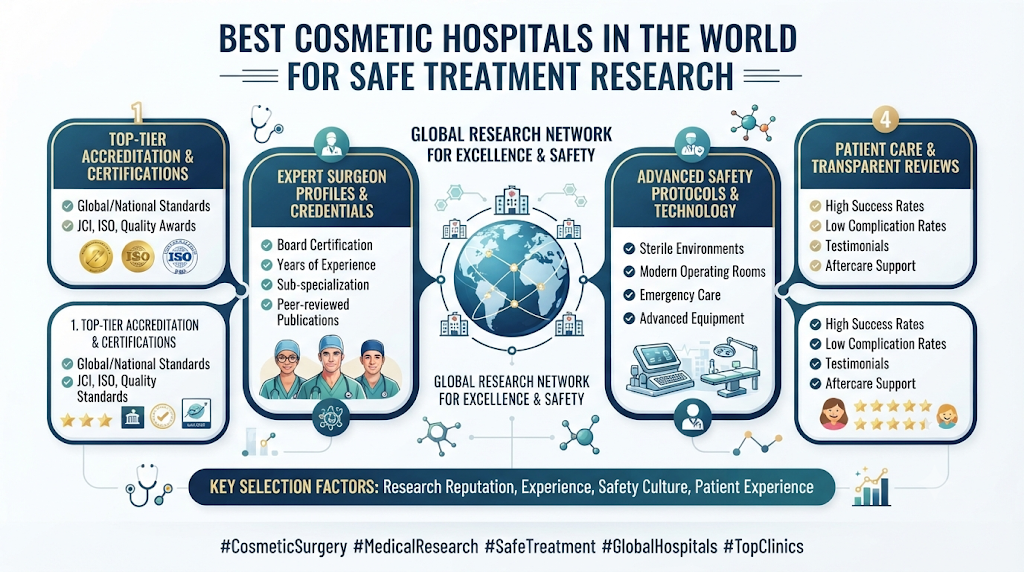
Best Cosmetic Hospitals in the World: Hospital Evaluation
A hospital or surgical facility should be evaluated using practical evidence.
Accreditation
Check whether the hospital is accredited by a recognised national or international body. Joint Commission International maintains a public directory of internationally accredited organisations. Accreditation can demonstrate that a facility has undergone an external assessment, but patients must still evaluate the relevant department, surgeon, and procedure.
Infrastructure
For significant surgery, ask whether the facility has:
- Properly equipped operating rooms
- Qualified anaesthesia professionals
- Continuous patient monitoring
- Sterilisation and infection-control procedures
- Emergency medicines and equipment
- Blood-bank access where relevant
- An intensive care unit or transfer agreement
- Overnight nursing support
- Written discharge procedures
Safety Standards
Ask how the hospital records surgical complications, handles emergencies, prevents infection, verifies implants, and transfers patients when a higher level of care is required.
International Patient Services
Helpful services may include interpreters, medical-record coordination, itemised estimates, airport transfers, visa letters, accommodation assistance, and telemedicine follow-ups. These services improve convenience but should not be mistaken for clinical quality.
Hospital Versus Clinic Comparison
| Factor | Cosmetic Hospital | Cosmetic Clinic |
| Facilities | May provide operating theatres, imaging, laboratories, inpatient rooms, and multiple specialties | May offer consultation rooms, procedure rooms, or limited surgical facilities |
| Surgical Support | Usually has broader nursing, anaesthesia, pharmacy, and diagnostic support | Depends greatly on clinic licensing, size, and procedure type |
| Emergency Care | May have an emergency department, ICU, blood services, or specialist backup | May depend on transfer arrangements with another hospital |
| Recovery Services | May offer inpatient observation and structured discharge support | Often provides outpatient recovery and external accommodation |
| Suitable Use | Often preferred for complex procedures or patients needing broader support | May be appropriate for selected procedures when properly licensed and equipped |
A clinic is not automatically unsafe, and a hospital is not automatically excellent. The correct setting depends on the operation, patient health, anaesthesia needs, and emergency requirements.
Best Cosmetic Surgeons in the World: Selection Criteria
There is no single universal ranking of the best cosmetic surgeons in the world. A surgeon who is highly experienced in rhinoplasty may not be the best choice for body contouring, breast revision, or hair restoration.Evaluate the following areas.
Medical Qualifications
Confirm where the surgeon completed medical school, surgical training, plastic-surgery training, and specialist examinations.
Board Certification
Determine which organisation awarded the certification and whether that organisation is officially recognised in the country where the surgeon practises. A general medical licence is not the same as specialist certification in plastic surgery.
Procedure Experience
Ask how frequently the surgeon performs the exact procedure, including complex or revision cases. Experience in one cosmetic field should not automatically be transferred to another.
Hospital Privileges
Ask whether the surgeon has permission to perform the proposed procedure at a recognised hospital. Hospital privileges can provide an additional level of professional review.
Professional Memberships
Membership in organisations such as ISAPS or recognised national plastic-surgery societies can support credential research. ISAPS provides an international surgeon directory, while ASPS recommends asking about specialist training, board certification, hospital privileges, facility accreditation, and complication management.
Consultation Quality
A responsible consultation should cover:
- Your goals and concerns
- Relevant medical history
- Available alternatives
- Procedure limitations
- Anaesthesia
- Scarring
- Expected recovery
- Possible complications
- Revision possibilities
- Follow-up care
- Total costs
Be cautious when a provider guarantees results, pressures you to pay immediately, avoids discussing risks, or proposes several major procedures without adequate assessment.
Plastic Surgery Cost by Country
A plastic surgery cost by country comparison can help with early budgeting, but it should never be used as the only selection method.Costs may include:
- Surgeon fees
- Assistant fees
- Anaesthesia
- Operating-room charges
- Hospital admission
- Medical tests
- Implants or specialist materials
- Medicines
- Compression garments
- Nursing
- Follow-up appointments
- Hotel accommodation
- Flights and local transportation
- Additional care following complications
Patients researching rhinoplasty cost by country, liposuction cost by country, breast augmentation cost by country, tummy tuck cost by country, or hair transplant cost by country should request written itemised estimates from several providers.
Estimated Plastic Surgery Cost by Country
| Country | Rhinoplasty | Liposuction | Breast Augmentation | Tummy Tuck | Hair Transplant |
| Turkey | $2,500–$6,500 | $2,500–$5,500 | $2,000–$5,000 | $3,500–$7,000 | $1,500–$5,000 |
| India | $3,000–$6,000 | $2,000–$5,000 | $3,000–$6,000 | $3,500–$7,000 | $1,000–$3,500 |
| Mexico | $3,000–$6,000 | $2,500–$5,000 | $3,500–$6,000 | $4,000–$7,000 | $2,500–$6,000 |
| Brazil | $3,000–$6,000 | $1,500–$3,500 | $3,300–$4,500 | $2,900–$4,500 | $2,000–$5,000 |
| Costa Rica | $3,500–$5,000 | $2,500–$4,000 | $3,500–$5,500 | $4,000–$5,500 | $2,500–$5,000 |
| Thailand | $3,000–$6,500 | $2,500–$6,000 | $4,000–$6,000 | $4,500–$8,000 | $2,500–$6,000 |
| South Korea | $4,000–$10,000 | $3,500–$9,000 | $7,000–$12,000 | $8,000–$15,000 | $4,000–$10,000 |
| United States | $8,000–$15,000 | $6,000–$10,000 | $8,000–$12,000 | $10,000–$15,000 | $8,000–$20,000 |
Important cost note: These are broad US-dollar planning estimates, not quotations. They may represent different combinations of surgeon, hospital, anaesthesia, implant, accommodation, and follow-up fees. Publicly available destination estimates show substantial variation even within the same country. ASPS also explains that its reported average US surgeon fees exclude expenses such as anaesthesia and operating-room facilities.Always ask whether the quotation includes revision treatment, emergency care, additional hospital nights, implant warranties, medicines, and follow-up after returning home.
Recovery and Safety Considerations
Cosmetic surgery recovery should be planned before booking flights or accommodation.
Understand the Recovery Stages
Early recovery may involve pain, swelling, bruising, limited movement, dressings, drains, compression garments, medicines, and help with daily activities. Visible healing does not always mean internal healing is complete.
Discuss Possible Risks
Depending on the procedure, possible risks may include infection, bleeding, anaesthesia complications, fluid collection, delayed healing, scarring, asymmetry, changes in sensation, blood clots, implant-related issues, dissatisfaction, or revision surgery.
Plan Travel Carefully
The CDC notes that travel after surgery may add to the risk of blood clots because both surgery and prolonged immobility are contributing factors. Patients should obtain individual clearance from their treating medical team before flying.
Arrange Follow-Up Care
Before travelling, obtain written answers to these questions:
- Who will examine me after surgery?
- How many local follow-ups are included?
- Who should I contact outside office hours?
- What symptoms require emergency care?
- Who will treat complications after I return home?
- Will my records be provided in a language my local doctor understands?
- Are telemedicine follow-ups included?
- Who pays for additional treatment?
Recent CDC research has continued to highlight infections and other adverse outcomes associated with travel-related cosmetic procedures, reinforcing the need for infection control, careful provider selection, and continuity of care.
Cosmetic Surgery Abroad Guide
Research the Procedure
Understand what the operation can and cannot achieve. Compare surgical and nonsurgical alternatives, anaesthesia requirements, scarring, recovery, and possible revision needs.
Verify the Hospital
Check national licensing, current accreditation status, operating-room standards, emergency resources, infection-control policies, and transfer arrangements.
Verify the Surgeon
Confirm specialist training, certification, licence status, professional memberships, procedure volume, hospital privileges, and responsibility for follow-up care.
Request a Proper Consultation
Avoid booking surgery based only on messages with a salesperson or patient coordinator. The operating surgeon should review your health information, goals, photographs, previous surgery, medicines, allergies, and relevant test results.
Obtain an Itemised Treatment Plan
The plan should name the surgeon, anaesthesia provider, hospital, procedure, technique, implant brand where relevant, number of hospital nights, medicines, follow-ups, exclusions, and cancellation terms.
Prepare for Travel
Check passport and visa requirements, destination advisories, accommodation accessibility, companion needs, ground transportation, travel insurance exclusions, and airline rules.
Plan Recovery
Select accommodation close to the hospital. Arrange help with meals, medicines, mobility, wound care, and transport. A holiday itinerary should not take priority over medical recovery.
Organise Follow-Up
Request copies of consultation notes, operative reports, implant details, prescriptions, test results, discharge instructions, and emergency contacts before leaving the country.
How BestCosmeticHospitals.com Helps Patients
BestCosmeticHospitals.com can be used as an early research and comparison resource for patients exploring cosmetic treatment internationally.The platform brings together information about:
- Cosmetic hospitals and clinics
- Treatment destinations
- Surgeon-selection considerations
- Common cosmetic procedures
- Cost differences between countries
- Recovery planning
- Hospital services
- International patient support
- Medical-travel preparation
- Patient-safety questions
The platform should be used to organise research and identify questions for consultation. Information found online should be independently verified with hospitals, licensing authorities, accreditation organisations, surgeons, and qualified medical professionals before making a treatment decision.
Frequently Asked Questions
1. Which are considered the best countries for plastic surgery?
Countries frequently researched include Turkey, South Korea, Thailand, India, Mexico, Brazil, the United States, Germany, and the UAE. The right destination depends on the procedure, surgeon, facility, budget, travel needs, and follow-up arrangements.
2. How do I choose a cosmetic surgeon?
Check recognised plastic-surgery qualifications, licensing, board certification, procedure-specific experience, hospital privileges, professional memberships, communication quality, and complication-management policies.
3. What should I verify before cosmetic surgery abroad?
Verify the hospital’s licence, accreditation, surgical facilities, emergency resources, surgeon credentials, anaesthesia arrangements, total cost, recovery requirements, medical records, and follow-up process.
4. Why do cosmetic surgery costs vary by country?
Costs differ because of local wages, facility expenses, insurance, regulation, surgeon demand, exchange rates, implant prices, taxes, accommodation, and what each treatment package includes.
5. How much does rhinoplasty cost internationally?
Broad estimates may range from approximately $2,500 in lower-cost markets to more than $15,000 in premium markets. Revision or complex functional rhinoplasty may cost considerably more.
6. How much does liposuction cost internationally?
Pricing may range from around $1,500 to more than $10,000. The number of treatment areas, fat volume, technology, facility, anaesthesia, and combined procedures influence the final price.
7. What affects hair transplant pricing?
The main factors include graft number, extraction technique, surgeon involvement, donor-hair quality, clinic location, medical-team qualifications, medicines, and aftercare.
8. What questions should I ask a cosmetic surgeon?
Ask about specialist certification, experience, technique, risks, anaesthesia, facility accreditation, expected recovery, scars, possible revisions, emergency care, total fees, and follow-up responsibilities.
9. How can I evaluate a cosmetic hospital?
Review accreditation, licensing, infection-control policies, operating rooms, nursing support, anaesthesia services, emergency capabilities, intensive-care access, patient communication, and written treatment procedures.
10. How does BestCosmeticHospitals.com help patients compare options?
The platform provides information about hospitals, surgeons, destinations, procedures, costs, recovery, and medical-travel planning. Patients should verify all important information independently before treatment.
Conclusion
Comparing the best cosmetic hospitals in the world requires a balanced review of medical quality, surgeon expertise, hospital facilities, treatment costs, recovery requirements, and international travel arrangements. A well-designed website, attractive package, positive review, or low price should never be treated as sufficient proof of safe and appropriate care.Begin by understanding the proposed procedure and its limitations. Verify that the surgeon has recognised specialist training, current licensing, appropriate board certification, procedure-specific experience, and hospital privileges.
