Best AI Prompt Management Tool for Better Workflows
Introduction
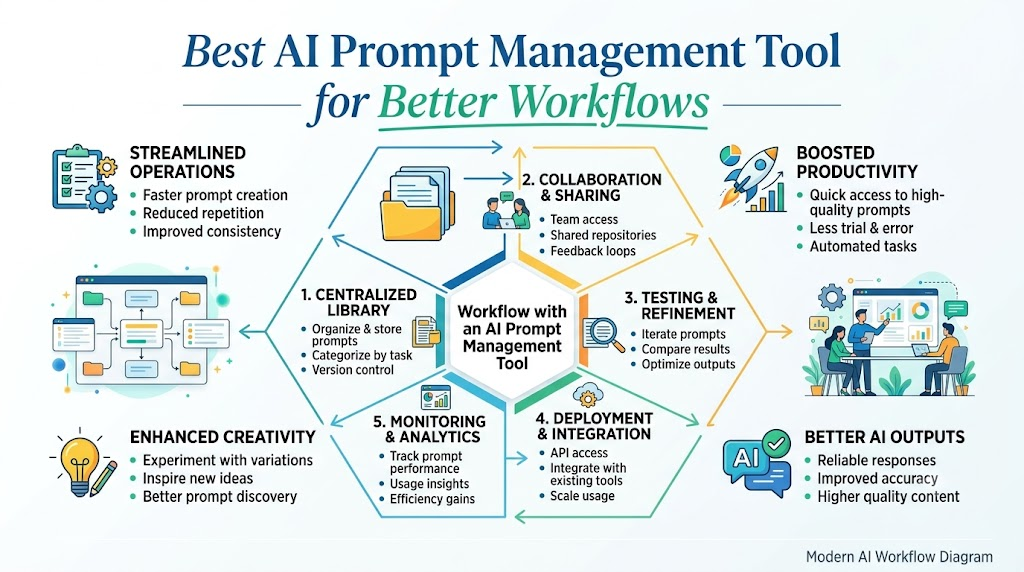
AI tools are only as effective as the prompts you give them. Whether you are generating code, writing content, analyzing data, or automating workflows, the quality of your input directly determines the quality of the output. This is why prompt engineering has become a critical skill across industries.However, as users create dozens or even hundreds of prompts, managing them becomes a challenge. Important prompts get lost, versions are overwritten, and results become inconsistent. Without structure, even experienced users struggle to maintain quality and scalability.This is where an AI prompt management tool becomes essential. It helps you organize, test, optimize, and reuse prompts efficiently across workflows.In this guide, you will learn how prompt engineering works, how to build reusable prompt systems, and how platforms like Promptosia help you manage prompts as valuable digital assets.
What Is an AI Prompt Management Tool?
Definition
An AI prompt management tool is a platform designed to help users create, organize, optimize, test, and reuse prompts across different AI systems. Instead of storing prompts in scattered notes or documents, it provides a structured environment for managing them.
Why Prompt Management Matters
As AI usage scales, prompt complexity increases. Managing prompts manually leads to inefficiencies, duplication, and inconsistent results. A structured system ensures reliability and repeatability.
Common Prompt Challenges
- Losing track of effective prompts
- Inconsistent outputs across sessions
- Difficulty in scaling workflows
- Lack of version tracking
- No standardized format
Benefits of Organized Prompt Libraries
- Centralized access through an AI prompt library
- Faster reuse of proven prompts
- Improved consistency in outputs
- Easier collaboration across teams
- Better optimization and testing workflows
Platforms like Promptosia’s prompt library system enable users to store, categorize, and reuse prompts efficiently.
Understanding Prompt Engineering
What Prompt Engineering Is
Prompt engineering is the process of designing inputs that guide AI models to produce accurate, relevant, and structured outputs. It is both a technical and creative discipline.
Prompt Components
- Context: Background information for the AI
- Instructions: Clear task definition
- Variables: Dynamic inputs for reuse
- Output formatting: Desired structure of response
- Constraints: Limits such as tone, length, or style
Example
Basic prompt:
“Write a blog about DevOps.”Optimized prompt:
“Write a 1,000-word beginner-friendly blog explaining DevOps principles, including CI/CD, automation, and monitoring. Use simple language and include examples.”Using a structured prompt engineering platform improves consistency and output quality.
Building an Organized AI Prompt Library
An effective AI prompt organizer transforms scattered prompts into structured assets.
Key Elements
- Categories: Writing, coding, marketing, research
- Tags: SEO, automation, debugging
- Variables: Dynamic fields for reuse
- Search: Quick retrieval of prompts
- Collections: Grouping related prompts
Why It Matters
Structured organization reduces duplication and saves time. Instead of rewriting prompts, you reuse and adapt them.Promptosia’s categorized collections and searchable library make this process efficient and scalable.
AI Prompt Optimization
An AI prompt optimizer helps refine prompts for clarity and performance.
Key Optimization Techniques
- Improve clarity by removing ambiguity
- Define roles (e.g., “Act as a DevOps expert”)
- Add structured instructions
- Specify output format
- Include constraints
Example
Before:
“Explain Kubernetes.”After:
“Explain Kubernetes in simple terms for beginners, including architecture, pods, and real-world use cases. Limit to 500 words.”Optimization leads to more consistent and high-quality outputs.
AI Prompt Analysis
An AI prompt analyzer evaluates prompt structure and effectiveness.
What It Analyzes
- Prompt structure
- Goal clarity
- Variable usage
- Output expectations
- Safety considerations
Why It Matters
Analysis helps identify gaps such as missing context or unclear instructions. Tools like Promptosia’s prompt analyzer provide insights into improving prompt performance.External reference: OpenAI prompt design guidelines emphasize clarity and specificity in prompts.
Prompt Quality Checking
A prompt quality checker ensures prompts meet defined standards.
Evaluation Criteria
- Clarity
- Context completeness
- Logical structure
- Reusability
- Safety
- Practical value
Scoring Systems
Quality scoring allows users to compare prompts and improve them iteratively.This process ensures that only high-performing prompts are reused in workflows.
Version Control for AI Prompts
A prompt version control tool tracks changes and improvements over time.
Why Versioning Matters
- Track prompt evolution
- Compare different versions
- Restore previous versions
- Manage experiments
Example
Version 1: Basic prompt
Version 2: Added constraints
Version 3: Improved formattingPromptosia’s version history feature allows users to manage prompt evolution effectively.
Testing AI Prompts
An AI prompt testing tool enables users to evaluate performance.
Testing Methods
- A/B testing different prompts
- Comparing outputs across models
- Measuring consistency
- Running experiments
Practical Scenario
Testing two prompts for blog generation can reveal which produces better SEO structure and readability.Promptosia’s prompt testing and prompt duels features allow side-by-side comparisons.
Reusable AI Prompt Templates
Reusable AI prompt templates streamline workflows across domains.
Use Cases
- Writing: Blog outlines, SEO articles
- Coding: Debugging, code generation
- Marketing: Ad copy, email campaigns
- Customer support: Response templates
- Research: Summaries, analysis
- Education: Lesson plans
- Business: Reports, proposals
- Productivity: Task automation
Reusable templates reduce effort and improve consistency.
Promptosia for Different User Types
Writers
Organize blog prompts and improve SEO content workflows.
Developers
Store debugging and code generation prompts.
Marketers
Create reusable campaign templates.
Students
Save study and research prompts.
Researchers
Structure data analysis queries.
Educators
Build teaching and curriculum prompts.
Businesses
Standardize internal workflows.
Content Creators
Manage multi-platform content prompts.
Agencies
Collaborate on shared prompt libraries.
AI Professionals
Optimize and test prompts at scale.
Best Practices for Prompt Management
- Save high-performing prompts.
- Organize by categories and tags.
- Use descriptive titles.
- Add variables for flexibility.
- Test prompts regularly.
- Maintain version history.
- Continuously optimize prompts.
- Document successful workflows.
Common Prompt Engineering Mistakes
- Vague instructions: Always be specific.
- Missing context: Provide background.
- Overly long prompts: Keep them structured.
- Poor formatting: Use clear sections.
- Lack of testing: Validate outputs.
- No version tracking: Track improvements.
- Ignoring optimization: Refine regularly.
Comparison Table
| Feature | Manual Prompt Storage | Promptosia |
|---|---|---|
| Organization | Scattered notes | Structured library |
| Version Control | Not available | Built-in version history |
| Search | Limited | Advanced search |
| Testing | Manual | Prompt testing tools |
| Quality Analysis | None | AI prompt analyzer |
| Collaboration | Difficult | Team-friendly |
The Future of Prompt Engineering
Prompt engineering is evolving into a standardized discipline. Key trends include:
- AI-assisted prompt optimization
- Collaborative prompt workflows
- Prompt marketplaces
- Standardized prompt formats
- Workflow automation
- Reusable AI assets
- Enterprise AI adoption
Resources such as Google AI documentation, Microsoft Learn AI modules, and Hugging Face guides highlight the growing importance of structured prompt systems.
How Promptosia Helps Users Build Better Prompts
Promptosia provides a complete ecosystem for managing prompts:
- Centralized prompt library for organization
- AI-assisted optimization tools
- Prompt analyzer for quality insights
- Version management for tracking changes
- Prompt testing and duels for comparisons
- Community sharing features
- Prompt passports for structured templates
These features help users treat prompts as reusable, scalable assets rather than disposable inputs.
Frequently Asked Questions (FAQ)
What is an AI prompt management tool?
An AI prompt management tool helps users organize, optimize, test, and reuse prompts efficiently. It centralizes prompts into a structured system, enabling better consistency and productivity across AI workflows. Instead of storing prompts in scattered documents, users can manage them as reusable digital assets.
Why should I save AI prompts?
Saving prompts allows you to reuse high-performing inputs, maintain consistency, and reduce repetitive work. It also helps in scaling workflows, especially when working on multiple projects or collaborating with teams.
What is prompt engineering?
Prompt engineering is the practice of designing effective inputs for AI systems. It involves structuring prompts with clear instructions, context, and constraints to achieve accurate and relevant outputs.
How does prompt optimization work?
Prompt optimization involves refining prompts to improve clarity, structure, and output quality. This includes adding context, defining roles, specifying formats, and reducing ambiguity.
Why is prompt testing important?
Testing ensures that prompts produce consistent and high-quality outputs. It helps compare different prompt versions and identify the most effective one.
What is prompt version control?
Prompt version control tracks changes made to prompts over time. It allows users to compare versions, restore previous ones, and manage prompt evolution effectively.
How does an AI prompt analyzer help?
An AI prompt analyzer evaluates prompt structure, clarity, and effectiveness. It provides insights into improving prompts by identifying missing elements or inefficiencies.
What makes a high-quality prompt?
A high-quality prompt is clear, structured, context-rich, and reusable. It includes precise instructions, defined outputs, and minimal ambiguity.
Can teams collaborate on prompt libraries?
Yes, prompt management platforms allow teams to share, organize, and collaborate on prompts, improving efficiency and standardization across workflows.
Who should use Promptosia?
Promptosia is useful for writers, developers, marketers, students, educators, businesses, and AI professionals who want to manage and optimize prompts effectively.
Conclusion
Managing prompts effectively is no longer optional in today’s AI-driven workflows. As prompt engineering becomes a critical skill, the need for structured systems to organize, test, and optimize prompts continues to grow.An AI prompt management tool enables users to move from scattered, inconsistent inputs to structured, reusable, and high-performing prompt systems. By organizing prompts into libraries, analyzing their effectiveness, and continuously improving them, users can significantly enhance productivity and output quality.
