Understanding FinOps Foundation Certification: A Guide to Cloud Financial Management
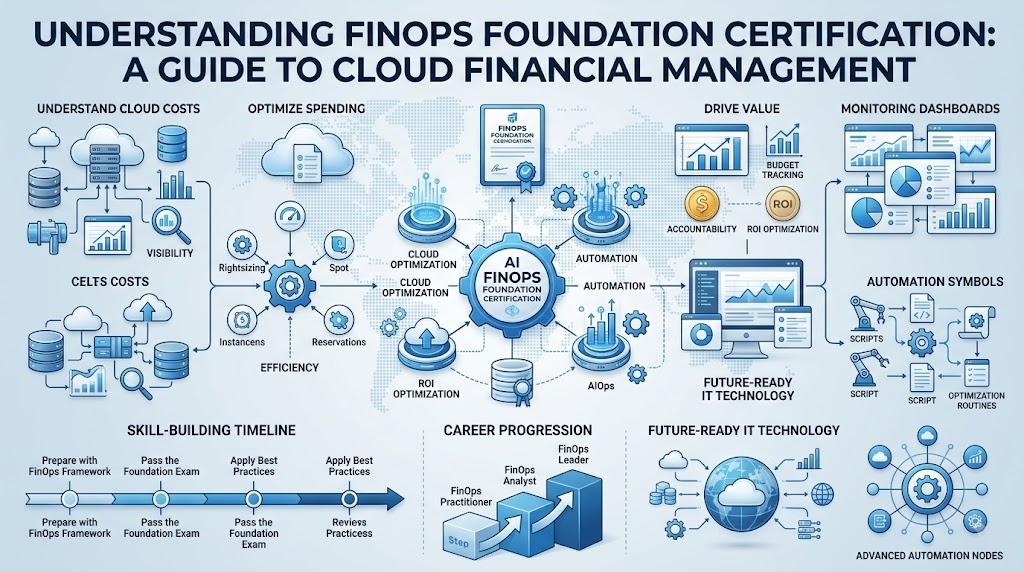
Cloud computing makes it easy to deploy infrastructure, scale applications, and experiment with new products. It also changes how organizations spend money. Instead of making occasional large capital purchases, teams can create resources on demand and incur variable, usage-based costs continuously.This is where FinOps becomes important. FinOps combines financial accountability, engineering practices, cloud operations, and business decision-making. It helps organizations understand technology spending, make cost-aware decisions, and maximize the value created by cloud investments.A FinOps Foundation Certification is designed for professionals who want to understand the FinOps Framework, cloud financial management practices, and the collaboration required between engineering, finance, procurement, and business teams.
What Is FinOps Foundation Certification?
FinOps Foundation Certification refers to credentials and learning programs offered through the FinOps Foundation’s education ecosystem. The best-known entry-level credential is FinOps Certified Practitioner, which focuses on foundational FinOps knowledge, the FinOps Framework, cloud economics, and the cultural practices needed to manage variable cloud spending.FinOps itself is not merely a toolset for reducing cloud bills. It is an operational framework and cultural practice that aims to maximize the business value of technology investments, enable data-driven decisions, and create financial accountability through collaboration among engineering, finance, and business teams.For professionals, certification can provide a structured way to learn common FinOps terminology, principles, capabilities, and workflows. It can also help teams develop a shared language when discussing cloud budgets, cost allocation, optimization opportunities, forecasts, and business outcomes.The credential should be viewed as professional development rather than a guarantee of employment, promotion, or compensation. Its value depends on how well a learner can apply FinOps thinking in real cloud environments.
What Is FinOps?
FinOps is short for Financial Operations. In simple terms, it is a collaborative way of managing cloud and technology spending.Traditional IT budgeting often involves fixed infrastructure costs and slow purchasing cycles. Cloud platforms work differently: teams can provision, resize, pause, or remove resources quickly. This flexibility creates opportunities for innovation, but it can also create unexpected spending if usage is not visible or managed.FinOps brings together three major groups:
- Engineering teams that build and run applications.
- Finance teams that manage budgets, forecasts, reporting, and financial controls.
- Business teams that evaluate product outcomes, customer value, growth, and priorities.
The goal is not simply to spend less. A FinOps practice helps an organization decide whether spending is efficient and whether it supports measurable business value.For example, an engineering team may increase cloud costs to improve application performance during a major sales event. A FinOps approach asks whether that extra cost increased revenue, customer retention, reliability, or another meaningful outcome. The best decision may be to spend more—but with clear accountability and evidence.
Why FinOps Matters
Organizations need FinOps because cloud spending is dynamic, distributed, and influenced by many technical decisions.Key reasons include:
- Cloud cost visibility: Teams need timely, accurate views of usage and spending.
- Cost control: Organizations can identify idle, oversized, duplicate, or unnecessary resources.
- Budget management: Budget owners can compare actual spending with planned spending.
- Forecasting: Teams can estimate future cloud costs using usage trends, commitments, and business plans.
- Resource optimization: Engineers can rightsize compute, storage, databases, and other cloud services.
- Financial accountability: Teams can understand the cost implications of their technology choices.
- Business value: Leaders can connect technology spending with product, customer, and operational outcomes.
- Better collaboration: Finance and engineering can make decisions from shared data instead of working in isolation.
FinOps does not replace cloud engineering, finance, procurement, security, or governance. It connects these disciplines so that cost, performance, speed, reliability, and business objectives can be evaluated together.
About the FinOps Foundation
The FinOps Foundation is part of the Linux Foundation and supports a global community focused on cloud financial management practices. It develops and maintains the FinOps Framework, education programs, training resources, and a shared vocabulary for practitioners and organizations.finops+1The FinOps Framework provides common building blocks for a FinOps practice. These include principles, personas, capabilities, maturity characteristics, measures of success, and functional activities.finopsThe Foundation also supports organizational recognition programs, including FinOps Certified Enterprise and FinOps Certified Platform certifications. These are organization-focused programs and should not be confused with individual professional credentials.finops+1
Certification Structure and Prerequisites
The FinOps Foundation training catalog includes foundational, advanced, and specialized programs. FinOps Certified Practitioner is generally the relevant starting point for individuals building foundational FinOps knowledge. The official training catalog also lists FinOps Certified Professional and FinOps Certified FOCUS Analyst among its offerings.finops+1The official learning platform offers self-paced and instructor-led options. For example, the FinOps Certified Practitioner virtual instructor-led course is described as a live two-day virtual class that includes access to course modules and the certification exam. The exam-only option provides up to three attempts over one year.Certification details can change, so learners should verify current format, pricing, exam objectives, eligibility, and retake rules directly through the official FinOps Foundation learning site before purchasing.
Official vs Recommended Prerequisites
Formal requirements vary by credential. Advanced certifications may require a current FinOps Certified Practitioner or FinOps Certified Engineer credential, according to the Foundation’s training FAQs. Credentials are valid for two years from the date of issue.For a foundational FinOps learning path, useful recommended knowledge includes:
- Basic cloud computing concepts and cloud billing models.
- Familiarity with AWS, Azure, Google Cloud, or another cloud platform.
- Awareness of budgets, cost centers, invoices, or forecasting.
- Experience working with engineering, operations, finance, or business stakeholders.
- Basic spreadsheet, reporting, or data-analysis skills.
A learner does not need to be an expert cloud architect or finance professional to begin. However, practical cloud exposure makes FinOps concepts easier to apply.
Skills You Can Gain
A FinOps Foundation Certification learning journey can help professionals build skills in the following areas:
| Skill Area | Practical Application |
|---|---|
| Cost visibility | Interpreting cloud billing and usage data |
| Cost allocation | Assigning costs to teams, products, projects, or cost centers |
| Budgeting | Creating spending targets and monitoring variance |
| Forecasting | Estimating future costs from trends and expected usage |
| Cost optimization | Identifying waste, rightsizing resources, and evaluating commitments |
| Cloud economics | Understanding variable pricing, consumption, and trade-offs |
| Reporting | Creating clear cost reports for technical and business audiences |
| Accountability | Helping owners understand and manage technology spend |
| Collaboration | Aligning engineering, finance, procurement, and leadership |
These skills are useful because FinOps requires both analytical work and communication. A technically correct report has limited value if product owners cannot understand the decision it supports.
FinOps Framework and Lifecycle
The FinOps Framework offers a common model for building and improving cloud financial management practices. It includes principles, personas, capabilities, maturity considerations, and measurable outcomes.The framework uses three iterative lifecycle phases:
| Phase | Core Purpose | Typical Activities |
|---|---|---|
| Inform | Build cost visibility and accountability | Allocation, reporting, budgeting, forecasting, benchmarking |
| Optimize | Improve efficiency and reduce avoidable waste | Rightsizing, rate optimization, architecture improvements |
| Operate | Govern and sustain business-value decisions | KPI tracking, governance, policy management, continuous improvement |
The Foundation describes these as Inform, Optimize, and Operate, not as one-time steps. Teams cycle through them repeatedly as conditions, products, priorities, and cloud usage change.
Inform
The Inform phase gives stakeholders access to accurate, timely cost and usage data. Organizations commonly establish tagging standards, cost allocation models, dashboards, budget reports, and forecasts here.For example, a company may allocate cloud costs by application, product team, environment, and customer segment. This helps decision-makers understand which workloads create the most spending and why.
Optimize
The Optimize phase identifies ways to improve efficiency without harming business outcomes. Actions may include removing idle resources, rightsizing virtual machines, using autoscaling, selecting appropriate storage tiers, or evaluating committed-use discounts.Optimization should not become indiscriminate cost cutting. Turning off a production resource that protects availability may reduce spending temporarily while creating a larger business risk.
Operate
The Operate phase embeds FinOps into day-to-day decision-making. Teams define governance processes, track KPIs, establish accountability, and review whether cloud spending delivers expected value.For instance, an organization might track cost per transaction, cost per active customer, or cost per product feature. These unit-economics measures link cloud cost to business activity.
FinOps Principles in Practice
The FinOps Framework emphasizes several guiding principles. Current Framework language includes collaboration, business-value-driven decisions, technology ownership, accessible and accurate data, central enablement, and use of the cloud’s variable cost model.learn.microsoft+1In practical terms:
- Teams collaborate instead of treating cloud spending as finance-only work.
- Business value informs decisions, not cost alone.
- Engineers take ownership of the financial impact of resources they deploy.
- Cost data is available, accurate, timely, and understandable.
- A central FinOps function enables standards, automation, and coordination.
- Teams use cloud flexibility to adjust continuously rather than relying only on annual reviews.
A practical example is a software team that discovers a development environment runs 24 hours a day despite being used only during business hours. The engineering team can automate shutdown schedules, finance can measure savings, and the product team can confirm that the change does not slow delivery.
Tools and Practical Use Cases
FinOps relies on categories of tools rather than one mandatory product. Common categories include:
- Native cloud billing and cost-management tools.
- Cost and usage data exports.
- Dashboards and business-intelligence reporting platforms.
- Budgeting and forecasting systems.
- Tagging and allocation tools.
- Resource inventory and optimization platforms.
- Governance, policy, and automation tools.
- Cloud-provider recommendation engines.
Cloud providers offer cost-management capabilities, but organizations often combine native tools with data warehouses, spreadsheets, dashboards, ticketing systems, and internal reporting workflows.Common FinOps use cases include:
- Creating a monthly cloud spend report by business unit.
- Building a tagging and cost-allocation model for shared services.
- Finding idle development resources and automating cleanup.
- Forecasting quarterly spend for a product launch.
- Comparing on-demand costs with savings plans, reservations, or committed-use options.
- Managing multi-cloud cost reporting across AWS, Azure, and Google Cloud.
- Tracking cost per customer, transaction, order, or workload.
Hands-On Projects and Preparation Roadmap
Practical work is one of the best ways to reinforce FinOps concepts. Consider building:
- A cloud cost dashboard that shows spend by service, account, team, and environment.
- A monthly variance report comparing budget, forecast, and actual spend.
- A tagging-quality report that identifies unallocated or incorrectly allocated costs.
- A rightsizing analysis for virtual machines, databases, or container workloads.
- A simple cost forecast based on historical usage and planned growth.
- A unit-economics report such as cloud cost per order or per active user.
Step-by-Step Preparation
- Learn cloud billing basics, including usage-based pricing and common cost drivers.
- Study the FinOps Framework, principles, personas, capabilities, and lifecycle.
- Review official FinOps Foundation training and credential information.
- Practice cost allocation, budgeting, reporting, and forecasting scenarios.
- Use a cloud cost-management tool or billing export in a sandbox environment.
- Work through resource optimization examples, including unused and oversized resources.
- Identify weak topics and revisit official learning materials.
- Confirm the current assessment requirements, access period, and retake rules before scheduling the exam.
Avoid memorizing definitions without understanding real decisions. FinOps professionals need to explain trade-offs, not just repeat terminology.
Career Paths and Related Learning
FinOps knowledge can support roles such as FinOps Practitioner, FinOps Analyst, FinOps Engineer, Cloud Cost Analyst, Cloud Financial Management Professional, Cloud Architect, Cloud Consultant, Platform Engineer, and DevOps Engineer.Responsibilities vary by organization. A FinOps Analyst may focus on reporting and forecasts, while a FinOps Engineer may build automation, allocation pipelines, or optimization workflows. Cloud architects and platform engineers may use FinOps practices to build cost-aware architectures and internal platforms.Salary and career progression depend on location, cloud experience, role scope, industry, technical depth, communication ability, and organization size. Certification alone does not determine compensation.
| Certification / Path | Main Focus | Best For | Key Skills |
|---|---|---|---|
| FinOps Foundation Certification | Cloud financial management and value | Cloud, finance, and business collaborators | Allocation, optimization, forecasting, accountability |
| Cloud certifications | Cloud services and platform capabilities | Engineers and administrators | Compute, networking, storage, security |
| DevOps certifications | Delivery and operational automation | DevOps and platform teams | CI/CD, IaC, observability, automation |
| Cloud architecture paths | Designing cloud solutions | Architects and technical leads | Scalability, resilience, security, cost-aware design |
| Data certifications | Data systems and analytics | Analysts and data professionals | Data modeling, BI, pipelines, governance |
Future of FinOps
FinOps is expanding beyond basic cost reduction toward broader technology-value management. Important trends include AI-assisted optimization, automated governance, multi-cloud financial management, sustainability-aware decisions, unit economics, and closer alignment with platform engineering.The FinOps Foundation’s recent Framework updates also reflect a broader technology focus, with language that extends beyond cloud-only cost data and emphasizes business value from technology investments.finops+1After foundational certification, learners may explore advanced FinOps programs, cloud architecture, DevOps, platform engineering, cloud consulting, cloud governance, data analytics, or cloud financial management specialization.
Key Takeaways
- FinOps combines engineering, finance, and business collaboration to improve technology-value decisions.
- FinOps Foundation Certification can provide structured learning in cloud financial management.
- The FinOps lifecycle is iterative: Inform, Optimize, and Operate.
- Strong FinOps practices require cost visibility, allocation, forecasting, optimization, and accountability.
- Practical projects are essential for applying FinOps concepts in real environments.
- FinOps certification can complement cloud, DevOps, architecture, and data learning paths.
- Certification supports professional development but does not guarantee a job, salary increase, or promotion.
FAQs
What is FinOps Foundation Certification?
FinOps Foundation Certification refers to professional learning and credential programs focused on FinOps practices, cloud financial management, and the FinOps Framework.
What does FinOps mean?
FinOps means Financial Operations. It is a collaborative practice for maximizing business value from cloud and technology spending.
Who should take FinOps Foundation Certification?
It can be relevant for FinOps practitioners, cloud engineers, DevOps engineers, architects, platform engineers, finance professionals, IT managers, consultants, and technology leaders.
Is FinOps Foundation Certification only for finance professionals?
No. FinOps is cross-functional. Engineering, finance, procurement, product, operations, and leadership roles can all benefit from FinOps knowledge.
Are there formal prerequisites for FinOps certification?
Requirements depend on the specific credential. Foundational learning benefits from basic cloud and finance knowledge, while advanced programs may have official certification prerequisites. Verify current requirements through official resources.finops
How long is a FinOps certification valid?
The FinOps Foundation training FAQs state that credentials are valid for two years from the date of issue.finops
How can I prepare for a FinOps Foundation Certification exam?
Study the official learning material, understand the FinOps Framework, practice cloud cost scenarios, build reporting or optimization projects, and review current official assessment details.
What is the FinOps lifecycle?
The FinOps lifecycle has three iterative phases: Inform, Optimize, and Operate.finops
What skills are important for a FinOps professional?
Important skills include cloud cost visibility, cost allocation, forecasting, budgeting, reporting, optimization, cloud economics, and cross-functional communication.
How does FinOps help with cloud cost optimization?
FinOps helps teams identify inefficient spending, improve accountability, rightsize resources, reduce waste, evaluate pricing options, and connect cost decisions to business value.
Can FinOps be used in multi-cloud environments?
Yes. FinOps practices can help organizations allocate, report on, forecast, and optimize spending across multiple cloud providers, though data normalization and governance may require additional effort.
Does FinOps certification guarantee a FinOps job?
No. Certification can demonstrate structured learning, but job outcomes depend on experience, skills, communication ability, market conditions, and the requirements of individual employers.
What should I learn after FinOps Foundation Certification?
Your next step may include advanced FinOps study, cloud architecture, DevOps, platform engineering, cloud governance, data analytics, or cloud consulting, depending on your career direction.
Conclusion
FinOps Foundation Certification can be a valuable learning step for professionals who want to understand cloud financial management, cloud economics, and cross-functional accountability. It introduces a practical way to connect technology decisions with spending, operational performance, and business value.The strongest FinOps practitioners do more than identify cost savings. They build transparent cost visibility, improve forecasts, encourage responsible engineering decisions, and help organizations invest in technology with greater confidence.
