Complete FinOps Foundation Certification Guide for Cloud Cost Management Skills
Introduction
Cloud computing makes it easy for organizations to launch services quickly, scale infrastructure, and pay only for what they consume. However, that flexibility can also make cloud spending difficult to understand and control. A small configuration change, unused resource, unexpected data-transfer pattern, or unowned cloud account can create unnecessary cost.This is where FinOps becomes important. FinOps brings finance, engineering, product, and leadership teams together to make informed technology-spending decisions. FinOps Foundation Certification helps professionals learn the shared language, practices, and framework behind cloud financial management.This guide explains what FinOps is, how FinOps Foundation certifications fit into professional development, the skills involved, practical use cases, and career directions.
What Is FinOps Foundation Certification?
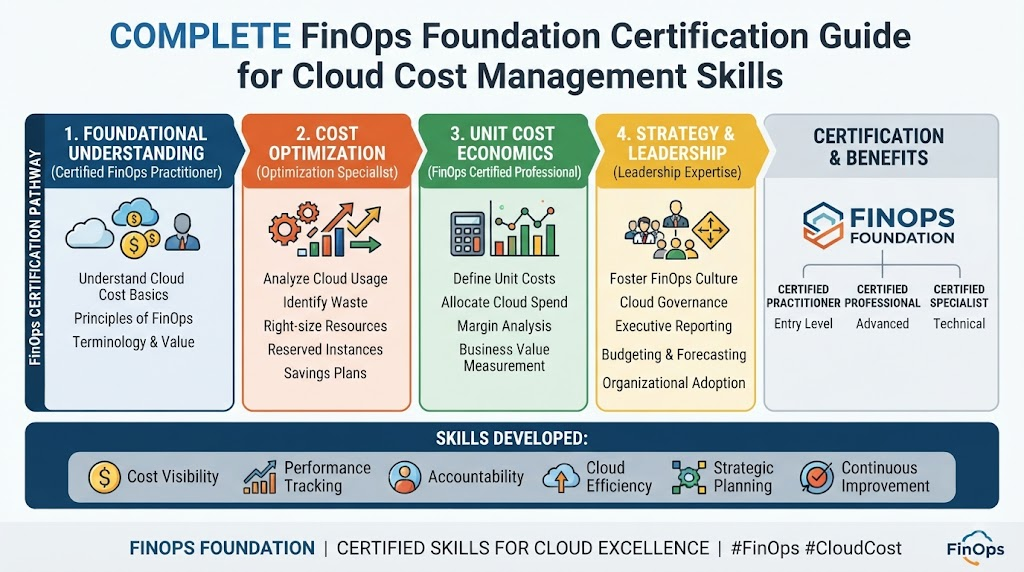
FinOps Foundation Certification refers to certification programs and learning paths provided by the FinOps Foundation for professionals working with cloud and technology costs. These programs help learners understand FinOps practices, the FinOps Framework, collaboration models, cloud economics, accountability, and value-driven decision-making.A certification is not simply about reducing cloud bills. It is about learning how to balance cost, speed, quality, risk, and business value. For example, a more expensive architecture may still be the right choice if it improves reliability for a revenue-critical application.The FinOps Foundation offers several role- and topic-oriented certifications, including FinOps Certified Practitioner, FinOps Certified FOCUS Analyst, FinOps Certified Professional, FinOps Certified AI Value, and Technology Value learning options. The appropriate path depends on a learner’s current role, experience, and goals.
What Is FinOps?
FinOps is an operational framework and cultural practice that helps organizations maximize the business value of technology spending. It enables timely, data-driven decisions and creates financial accountability through collaboration among engineering, finance, and business teams.In simple terms, FinOps helps answer questions such as:
- Which teams, products, or customers are creating cloud costs?
- Are cloud resources being used efficiently?
- Can the organization predict next month’s spending?
- Which optimization actions will have the highest business impact?
- Is a cloud investment producing measurable value?
FinOps does not make engineering teams responsible for finance alone. Instead, it creates shared responsibility. Engineers understand the cost effects of their architecture and usage decisions, finance teams provide planning and governance expertise, and business leaders connect spending to outcomes.
Why FinOps Matters for Modern Businesses
Cloud costs are variable. Spending can change daily based on traffic, storage growth, analytics workloads, artificial intelligence usage, testing environments, or new product releases. Traditional annual budgeting methods often cannot keep up with this pace.FinOps helps organizations improve:
- Cost visibility: Teams can see where spending occurs and who owns it.
- Cost control: Organizations can identify waste, unexpected usage, and unnecessary resources.
- Forecasting: Finance and engineering teams can estimate likely future costs using usage trends and planned changes.
- Budget management: Product teams can compare actual spending against budgets and investigate major variances.
- Resource optimization: Teams can rightsize compute, remove idle resources, optimize storage, and assess commitments.
- Decision-making: Leaders can evaluate cloud spending in the context of product growth, customer usage, reliability, and unit economics.
- Collaboration: Engineering, finance, product, procurement, and leadership work from more consistent information.
The goal is not “spend as little as possible.” The goal is to spend intentionally and gain the right value from each technology investment.
About the FinOps Foundation
The FinOps Foundation supports the FinOps community through a shared framework, education, training, community collaboration, and open practices. Its framework provides common terminology that helps organizations build and mature FinOps practices across cloud, SaaS, licensing, data platforms, private infrastructure, and other technology categories.The framework is designed to be flexible rather than prescriptive. An organization can begin with its most urgent need—such as cloud cost allocation or forecasting—and mature over time rather than trying to implement every capability at once.
Certifications and Learning Levels
The FinOps Foundation separates introductory learning, certifications, specialized topics, and advanced professional development.
| Learning option | Typical focus | Best suited for |
|---|---|---|
| Introduction to FinOps | Beginner overview of core FinOps activities | New learners exploring the discipline |
| FinOps Certified Practitioner | Foundational FinOps concepts and Framework knowledge | Engineers, finance professionals, managers, and cloud practitioners |
| FinOps Certified FOCUS Analyst | FinOps Open Cost and Usage Specification (FOCUS) knowledge | Analysts and professionals working with normalized cost data |
| FinOps Certified Professional | Advanced practice, strategy, and professional contribution | Experienced FinOps practitioners |
| Topic-focused learning | Areas such as AI value, technology value, containers, engineering, finance, leadership, or procurement | Professionals building targeted expertise |
The free Introduction to FinOps course is beginner-level and takes approximately 1.5 hours, but completing it alone does not make someone FinOps certified.For the standalone FinOps Certified Practitioner exam, the published format is 50 multiple-choice questions, a one-hour time limit, a 75% passing score, and up to three attempts within 12 months of purchase. Candidates should always check official course pages before registering because requirements and offerings can change.
Who Should Consider FinOps Certification?
FinOps learning can be useful for professionals who influence cloud spending, design cloud services, interpret billing data, manage budgets, or connect technology decisions with business outcomes.
Relevant roles include:
- Cloud Engineers and DevOps Engineers
- Platform Engineers and Site Reliability Engineers
- Cloud Architects
- FinOps Practitioners and FinOps Analysts
- Finance, procurement, and IT financial management professionals
- Engineering Managers and IT Managers
- Product, data, and technology leaders
- Cloud consultants and managed-service professionals
Not every professional in these roles needs certification. However, structured FinOps learning can help them collaborate more effectively and make cloud cost a visible engineering and business consideration.
Eligibility and Prerequisites
Formal requirements vary by certification. The FinOps Certified Practitioner path is generally suitable for learners who are new to FinOps and want a structured foundation. Familiarity with basic cloud concepts, consumption-based pricing, billing terms, and at least one cloud provider is helpful, but learners should verify official requirements for their selected option.Advanced programs have clearer prerequisites. For example, the FinOps Certified Professional path requires an active FinOps Certified Practitioner certification and at least six months of FinOps working experience before beginning the course; an active FinOps Certified FOCUS Analyst credential is required before taking its exam.
Recommended preparation includes:
- Basic understanding of AWS, Azure, Google Cloud, or another technology environment
- Familiarity with pay-as-you-go pricing
- Comfort reading usage and billing reports
- Basic spreadsheet, dashboard, or data-analysis skills
- Interest in both technical and financial decision-making
Skills You Can Gain
FinOps certification preparation can build practical knowledge in several areas:
- Cloud cost visibility and reporting
- Cost allocation using tags, labels, accounts, subscriptions, projects, or cost centers
- Budgeting and cloud-spend forecasting
- Resource rightsizing and waste identification
- Usage, rate, and commitment optimization
- Cloud economics and consumption-based pricing
- Financial accountability for product and engineering teams
- Stakeholder communication and cross-functional collaboration
- Unit economics, such as cost per customer, transaction, workload, or feature
- Data-driven decision-making
For example, instead of reporting that “cloud cost increased by 20%,” a FinOps-aware team may explain that cost per transaction fell by 8% while transaction volume grew. That connects spend to business value.
FinOps Framework, Principles, and Lifecycle
Framework concepts
The FinOps Framework includes core personas, domains, capabilities, scopes, measures of success, maturity characteristics, and principles. A FinOps Scope is a defined area of technology spend aligned to business constructs such as a product, cost center, or environment.
| Framework element | Simple meaning |
|---|---|
| Personas | People involved, including FinOps, engineering, finance, leadership, procurement, and product |
| Domains | Desired business outcomes |
| Capabilities | Activities used to achieve those outcomes |
| Scopes | Defined segments of technology spend |
| Maturity | Progress from reactive practices toward proactive, repeatable operations |
The four primary Framework domains are:
- Understand Usage and Cost
- Quantify Business Value
- Optimize Usage and Cost
- Manage the FinOps Practice
Relevant capabilities include allocation, reporting and analytics, anomaly management, forecasting, budgeting, unit economics, usage optimization, rate optimization, governance, education, invoicing, and automation.
FinOps principles
The FinOps Foundation presents six principles that guide successful practices:
- Teams need to collaborate.
- Business value drives technology decisions.
- Everyone takes ownership of their technology usage.
- FinOps data should be accessible, timely, and accurate.
- FinOps should be enabled centrally.
- Organizations should take advantage of the variable cost model of cloud and technology.
In practice, a central FinOps team may establish reporting standards and negotiate commitments, while product engineers retain accountability for the resources and services they choose.
FinOps lifecycle
The traditional FinOps lifecycle uses three iterative phases:
| Phase | Main question | Example activity |
|---|---|---|
| Inform | What are we spending, and why? | Improve billing data, allocation, dashboards, and reporting |
| Optimize | How can we improve cost efficiency? | Rightsize resources or reduce idle capacity |
| Operate | How do we sustain accountable decisions? | Set forecasts, budgets, governance, and regular reviews |
Organizations commonly mature through “Crawl, Walk, Run.” A Crawl-stage practice may react to cost issues after receiving a bill, while a Run-stage practice builds cost considerations into architecture design and engineering workflows.
Cloud Financial Management and Optimization
Effective cloud financial management starts with reliable data. Teams should define ownership for cloud accounts, subscriptions, projects, workloads, and business units. Without allocation, a large cloud bill is difficult to turn into action.Practical optimization work can include:
- Detecting unused virtual machines, storage volumes, IP addresses, snapshots, and test environments
- Rightsizing compute instances based on actual usage rather than initial estimates
- Scheduling non-production resources to run only when needed
- Reviewing storage tiering, data retention, and data-transfer patterns
- Using budgets and anomaly alerts to identify unexpected increases early
- Evaluating savings plans, reserved capacity, committed-use discounts, or other pricing models
- Tracking cost per product, customer, transaction, or workload where appropriate
Optimization should not be performed blindly. Turning off a lightly used service might reduce cost but harm availability or security. Teams need to evaluate cost, performance, reliability, and business impact together.
Tools, Use Cases, and Hands-On Projects
FinOps teams typically use a combination of cloud-native billing tools, cost-management platforms, reporting tools, data warehouses, dashboards, tagging policies, and automation systems. The most useful tool is one that produces trusted, timely, actionable information for the people who make decisions.Common tool categories include:
- Cloud billing and cost-management services
- Cost allocation and tagging governance tools
- Budgeting, forecasting, and anomaly-detection tools
- Business-intelligence dashboards
- Optimization and rightsizing tools
- Infrastructure-as-code policy and automation tools
A practical use case is a SaaS company that allocates cloud spend by product environment and customer tier. It can identify a rapidly growing analytics workload, forecast its cost, decide whether to optimize queries or buy a commitment, and measure cost per active customer.Useful hands-on projects include:
- Build a cloud cost dashboard showing monthly spend by service, account, environment, and team.
- Create a tagging or labeling standard and measure allocation coverage.
- Compare budgeted versus actual spend and explain major variances.
- Analyze a sample workload for idle resources and rightsizing opportunities.
- Produce a monthly report connecting cloud cost to a business metric, such as transactions or users.
Preparation Roadmap and Study Tips
A practical FinOps Foundation Certification preparation plan is:
- Learn FinOps fundamentals and cloud billing basics.
- Study the FinOps Framework, especially principles, personas, domains, capabilities, and lifecycle.
- Review the official learning page, course outline, and exam information for the specific certification.
- Learn cloud economics, including variable pricing, discounts, commitments, allocation, and forecasting.
- Work through realistic scenarios involving budget variances, tagging gaps, waste, and business trade-offs.
- Identify weak areas and revisit official materials.
- Schedule the assessment only after understanding concepts well enough to apply them.
Use official FinOps Foundation resources first. Then reinforce learning with cloud-provider billing documentation, sample cost-and-usage reports, dashboard exercises, and community discussions. Avoid relying only on memorized definitions; FinOps is most valuable when concepts can be applied to decisions.
Common Mistakes to Avoid
- Studying terminology without understanding real billing and usage scenarios
- Treating FinOps as an engineering-only or finance-only responsibility
- Ignoring cost allocation and ownership
- Focusing only on discounts while overlooking waste and architecture choices
- Reducing spend without considering availability, performance, security, or customer impact
- Ignoring business-value measures such as unit cost
- Assuming one dashboard or monthly report creates a mature FinOps practice
- Relying entirely on memorization instead of practical exercises
Career Opportunities and Growth
FinOps skills can support roles such as FinOps Practitioner, FinOps Analyst, Cloud Cost Analyst, Cloud Financial Management Professional, FinOps Engineer, Cloud Architect, and Cloud Consultant. Titles vary widely: one organization may have a dedicated FinOps team, while another distributes FinOps responsibilities across cloud engineering, finance, platform, and procurement teams.Compensation depends on experience, location, cloud-provider knowledge, technical depth, analytical skills, industry, company size, and the scope of the role. Certification can demonstrate structured knowledge, but practical experience with billing data, optimization decisions, reporting, and stakeholder communication is equally important.
FinOps Certification vs Related Paths
| Path | Primary objective | Typical focus |
|---|---|---|
| FinOps certification | Improve technology-value and cost decisions | Cost allocation, forecasting, optimization, accountability, collaboration |
| Cloud certification | Validate cloud platform knowledge | Compute, networking, storage, security, services |
| DevOps certification | Improve software delivery and operations | CI/CD, automation, monitoring, infrastructure as code |
| Cloud architecture certification | Design effective cloud systems | Reliability, scalability, security, architecture trade-offs |
| Data or analytics certification | Analyze and communicate data | Data modeling, reporting, visualization, governance |
These paths complement one another. A cloud architect with FinOps knowledge can include cost trade-offs in design decisions. A DevOps engineer can integrate cost guardrails into deployment workflows. A finance analyst can interpret technical consumption data more effectively.
Future of FinOps
FinOps is expanding beyond public-cloud cost management. Modern practices increasingly address AI usage, SaaS, licenses, data platforms, private infrastructure, sustainability, and broader technology value. The framework explicitly recognizes multiple technology categories and supports a scope-based approach to managing them.Key trends include multi-cloud financial management, automated optimization, AI-assisted cost analysis, unit economics, sustainability-aware decisions, and stronger integration with platform engineering. As technology spend becomes more consumption-based, organizations will need clearer ownership, better data, and faster feedback loops.
FAQs
1. What is FinOps Foundation Certification?
It is a certification and learning ecosystem from the FinOps Foundation that helps professionals develop cloud financial management, technology-value, and cross-functional collaboration skills.
2. Is FinOps only about reducing cloud costs?
No. FinOps focuses on maximizing business value from technology spending. Cost optimization matters, but so do performance, reliability, speed, risk, and business outcomes.
3. Who can learn FinOps?
Cloud engineers, DevOps professionals, finance specialists, architects, managers, analysts, consultants, and technology leaders can all benefit from FinOps knowledge.
4. Are there formal prerequisites for FinOps Certified Practitioner?
Requirements can change, so learners should review the official course or exam page. Basic cloud knowledge and familiarity with consumption-based billing are useful preparation.
5. How should beginners prepare for FinOps learning?
Start with FinOps fundamentals, learn cloud billing concepts, study the Framework, and practice analyzing simple cloud-cost reports and allocation scenarios.
6. What is cloud cost allocation?
Cloud cost allocation is the process of assigning spending to the teams, products, projects, customers, environments, or cost centers that created it.
7. How does FinOps help DevOps engineers?
FinOps helps DevOps engineers consider cost alongside reliability, deployment speed, performance, and security when designing and operating cloud workloads.
8. What is the FinOps Framework lifecycle?
The lifecycle is commonly described as Inform, Optimize, and Operate. It is iterative, meaning teams continuously improve visibility, efficiency, and operational accountability.
9. Where can I practice FinOps skills?
You can practice using cloud-provider billing data, sample cost reports, dashboards, tagging standards, budget alerts, and resource-optimization exercises.
10. Does FinOps certification guarantee a job?
No certification guarantees employment. It can strengthen knowledge and credibility, but employers also value practical cloud, analytical, communication, and problem-solving experience.
11. What is a FinOps Practitioner role?
A FinOps Practitioner helps organizations understand technology spend, improve allocation and reporting, identify optimization opportunities, support forecasting, and coordinate stakeholders.
12. When should an organization start FinOps?
Organizations should start when cloud or technology spending needs more visibility, ownership, forecasting, or optimization. Beginning with a small, high-impact scope is often more practical than attempting a large rollout.
Conclusion
FinOps Foundation Certification can provide a useful structure for learning cloud financial management and understanding how finance, engineering, and business teams make better technology decisions together. The discipline goes beyond cost cutting by connecting usage, cost, accountability, and measurable business value.For professionals, certification can fit well alongside cloud, DevOps, architecture, analytics, or finance experience. The strongest learning path combines official study material with hands-on work: analyze cost data, build dashboards, improve allocation, investigate anomalies, and evaluate optimization decisions in context. As cloud and broader technology spending become more complex, practical FinOps skills will remain valuable for teams that want to use technology efficiently and responsibly.