SRE Certified Professional (SRECP) Certification by DevOpsSchool: Complete Guide
Introduction
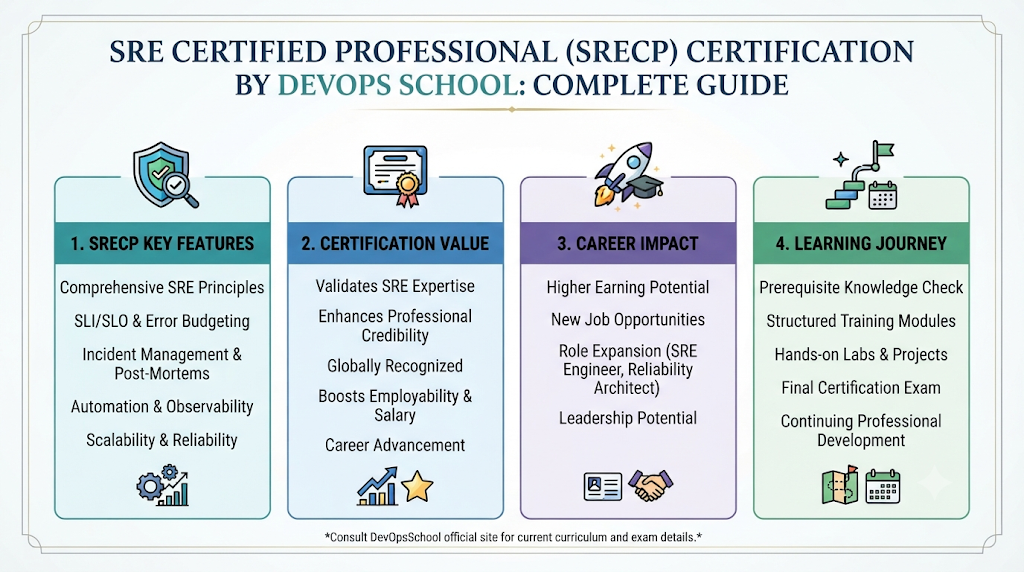
The SRE Certified Professional (SRECP) is a hands-on Site Reliability Engineering certification from DevOpsSchool that focuses on building reliable, observable, and automation-driven production systems.
What it is
In practical terms, SRECP trains you to apply software engineering to operations: define SLOs, reduce toil, automate repeatable work, and improve incident response. The program is built around real lab work, capstones, and an open-book scenario exam rather than slide-based theory.
Who should take it
This certification fits DevOps engineers, SREs, platform engineers, cloud engineers, and anyone moving into reliability, observability, or production operations roles. It is also useful for security, data, and engineering leaders who want a stronger operational and reliability foundation.
SRECP Certification Overview
The program is delivered via SRE Certified Professional (SRECP) and hosted on DevOpsSchool. It is structured as a practitioner-first course with live demos, labs, assignments, capstones, and a final 3-hour open-book scenario-based exam.In practical terms, the certification spans foundational SRE concepts, cloud platforms, containers, Kubernetes, infrastructure as code, observability, security, incident response, and automation. Assessment is scenario-based rather than memorization-heavy, so the ownership lies in demonstrating you can design, troubleshoot, and operate production systems.
Skills you'll gain
- Define SLIs, SLOs, error budgets, and reliability targets.
- Reduce toil through scripting, automation, and runbook execution.
- Build and troubleshoot CI/CD, IaC, Kubernetes, and cloud-native delivery pipelines.
- Improve observability with Prometheus, Grafana, OpenTelemetry, tracing, and logging.
- Handle incident response, postmortems, paging workflows, and on-call discipline.
- Apply DevSecOps controls such as SAST, DAST, SBOM, secrets handling, and policy-based security.
Real-world projects
- Design a multi-AZ, multi-region cloud setup with documented failure recovery.
- Create SLO dashboards and multi-window burn-rate alerts for a live service.
- Build a Kubernetes deployment with autoscaling, probes, and resilience testing.
- Implement Terraform-based infrastructure with drift detection and rollback paths.
- Automate incident response using PagerDuty/Opsgenie and runbook workflows.
- Build an observability stack with OTel instrumentation and trace-based debugging.
Common mistakes
- Treating SRE as only monitoring instead of reliability engineering plus automation.
- Ignoring SLOs and jumping straight into tools without service objectives.
- Over-relying on manual operations instead of codified runbooks and automation.
- Skipping incident analysis and postmortems, which are core SRE habits.
- Learning Kubernetes or cloud tooling in isolation instead of as part of an end-to-end production system.
Best next certificationIf your goal is pure SRE depth, the best next step is a stronger SRE or observability-focused certification path from the same ecosystem, such as SRE Foundation or advanced SRE training on DevOpsSchool’s broader SRE track. If you want broader career expansion, a cross-track option like DevSecOps, Observability, or MLOps/AIOps is usually the most practical next move based on the same toolchain overlap.
Complete Topic name Certification Table
| Track | Level | Who it’s for | Prerequisites | Skills Covered | Recommended Order | |
|---|---|---|---|---|---|---|
| SRE | Professional | DevOps, SRE, platform, cloud engineers | Linux, Git, basic cloud familiarity | SLIs/SLOs, observability, incident response, IaC, Kubernetes, automation | 1 | |
| DevOps | Foundation to advanced | Engineers starting with CI/CD and automation | Basic Linux and scripting | CI/CD, delivery pipelines, IaC, containers | 1 or 2 | |
| DevSecOps | Professional | Security-aware DevOps and platform engineers | DevOps basics | SAST, DAST, secrets, policy-as-code, secure delivery | 2 | |
| AIOps/MLOps | Professional | AI ops, automation, and ML platform teams | Cloud and monitoring basics | Automation intelligence, model delivery, telemetry-driven ops | 3 | |
| DataOps | Professional | Data platform and analytics engineers | Data pipeline basics | Data reliability, pipeline operations, quality and freshness monitoring | 3 | |
| FinOps | Practitioner | Cloud cost and platform owners | Cloud billing basics | Cost allocation, optimization, cloud governance | 3 |
Choose your path
- DevOps: Start with DevOps fundamentals, then move into SRECP to connect delivery speed with reliability.
- DevSecOps: Add secure delivery after SRECP to strengthen software supply-chain and runtime controls.
- SRE: Stay on the reliability track with deeper observability, incident management, and production engineering.
- AIOps/MLOps: Pair SRECP with AI-driven operations or ML deployment for intelligent automation and monitoring.
- DataOps: Use SRECP to make data pipelines more reliable, observable, and SLA-aware.
- FinOps: Combine SRECP with FinOps so reliability work also considers cloud spend, efficiency, and governance.
Role → Recommended certifications
| Role | Recommended certifications |
|---|---|
| DevOps Engineer | DevOps certification → SRECP |
| SRE | SRECP → advanced SRE / observability track |
| Platform Engineer | SRECP → Kubernetes / IaC / GitOps track |
| Cloud Engineer | Cloud fundamentals → SRECP → cloud reliability specialization |
| Security Engineer | DevSecOps → SRECP for production reliability context |
| Data Engineer | DataOps → SRECP for pipeline reliability |
| FinOps Practitioner | FinOps → SRECP for operational efficiency and reliability trade-offs |
| Engineering Manager | SRECP → leadership-focused reliability or platform governance track |
Training institutionsDevOpsSchool, Cotocus, Scmgalaxy, BestDevOps, Devsecopsschool, Sreschool, Aiopsschool, Dataopsschool, and Finopsschool are known in the broader DevOps, SRE, DevSecOps, AIOps, DataOps, and FinOps training space. Among them, DevOpsSchool is the official host for SRECP, while the others can be positioned as adjacent learning and training brands for related skills. For strong certification preparation, the better choice is always a provider that offers hands-on labs, project work, and exam-oriented mentoring rather than theory-only sessions. The most useful value comes from training that maps directly to production tools, troubleshooting practice, and portfolio-ready outputs.
Next certifications to take
- Same track: SRE Foundation or an advanced SRE training path for deeper reliability engineering.
- Cross-track: DevSecOps certification if you want to add secure delivery and security engineering depth.
- Leadership: Engineering manager or DevOps manager certification if you want to lead reliability programs and operating models.
FAQs
- What is SRECP?
SRECP is DevOpsSchool’s Site Reliability Engineering certification focused on reliability, automation, observability, and incident handling. - Is it theory-based or practical?
It is practical, with live demos, labs, assignments, capstones, and an open-book scenario exam. - What tools are covered?
The curriculum includes Linux, AWS, Azure, Docker, Python, Git, Jenkins, Kubernetes, Terraform, Prometheus, Grafana, OpenTelemetry, ELK, Vault, PagerDuty, RunDeck, and more. - Do I need prior SRE experience?
No, but Linux and basic Git help a lot because the program builds from fundamentals into production workflows. - How is assessment done?
Assessment is scenario-based and open-book, with a 3-hour online exam at the end of the program. - What projects will I complete?
You work on production-style projects such as cloud resilience, Kubernetes, IaC, observability, and incident response automation. - Is this useful for DevOps engineers?
Yes, because it connects delivery automation with service reliability, which is a core DevOps-to-SRE progression. - Does it help with observability roles?
Yes, because the curriculum includes Prometheus, Grafana, OpenTelemetry, Jaeger, ELK, and alerting practices. - Is DevOpsSchool the official provider?
Yes, SRECP is hosted and delivered by DevOpsSchool. - What is the best follow-up after SRECP?
The best follow-up is a deeper SRE or observability track, or a cross-track move into DevSecOps, depending on your career goal.
Why Choose DevOpsSchool?
DevOpsSchool is a strong choice because it positions SRECP as a hands-on, production-oriented program with live demos, your own lab, multiple capstones, and a scenario-based exam. The platform also ties SRECP into a broader certification ecosystem, so you can continue into DevOps, DevSecOps, AIOps, DataOps, or FinOps without changing training providers. For learners who want practical portfolio artifacts rather than theory-only content, that structure is especially useful.
Conclusion
SRE Certified Professional (SRECP) is best suited for learners who want to build real reliability engineering capability, not just understand the terminology. If your goal is stronger production operations, better incident handling, and a portfolio of practical work, it is a relevant and career-useful certification.
