DataOps Training for Cloud Engineering and Data Pipeline Management
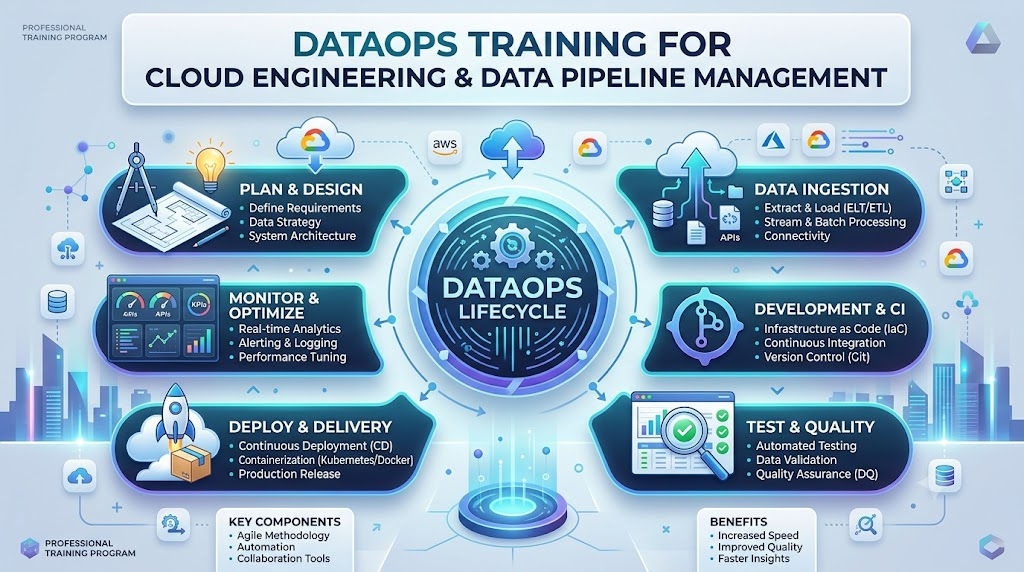
Introduction
Organizations frequently invest millions of dollars into modern cloud data warehouses, lakehouses, and business intelligence suites, only to watch business leaders revert to maintaining their own spreadsheets. The issue is rarely a lack of compute or visual tooling; it is a fundamental breakdown of consumer trust. When analytical tables break without warning, metrics disagree across departments, and turnaround times for simple data adjustments take weeks, data ceases to function as a reliable corporate asset.Understanding what is DataOps requires shifting focus from raw infrastructure mechanics to viewing data as an operational product. In modern software companies, successful digital products are governed by clear consumer expectations, automated quality assurances, predictable release cycles, and rapid iteration. DataOps applies this exact discipline to analytical ecosystems.By aligning upstream data producers, engineering delivery teams, and downstream business consumers around shared operational standards, DataOps establishes a predictable lifecycle for analytical assets. This guide outlines how adopting automated validation, continuous delivery, and contract-driven design transforms vulnerable pipelines into high-value data products.
6. Main Article
Reframing the Asset: What Is DataOps from a Product Perspective?
When looking past the technical tooling, what is DataOps to an organization that depends on numbers to make multi-million-dollar decisions? It is the operational discipline that treats data assets not as byproduct exhaust from business applications, but as standalone, high-integrity products delivered to internal and external consumers.In an undisciplined data organization, pipelines are treated as bespoke scripts owned by individual engineers. When an engineer departs, the undocumented transformation rules, hidden business definitions, and manual cron triggers become operational landmines. Downstream analysts have no visibility into when records arrive, whether intermediate aggregations succeeded, or if the underlying business definitions changed.DataOps resolves this disconnect by applying software product lifecycle standards to data workflows. It introduces version control to every analytical definition, enforces automated testing contracts between data producers and consumers, provides transparent operational status via observability, and ensures that platform modifications follow structured, non-disruptive continuous release pipelines.
The Consumer Trust Crisis in Modern Data Platforms
Without product-oriented operational standards, data platforms fall into predictable operational failure modes that alienate business stakeholders:
- The Broken Data Contract: Operational microservice teams change payment status values or drop legacy database columns to satisfy application feature work, completely unaware that these alterations invalidate financial reporting layers downstream.
- The Black-Box Pipeline: Business consumers open dashboards each morning with no mechanism to verify whether tables reflect yesterday's close or stale data from three days prior.
- Runaway Cycle Times: Because making changes to transformations carries high risk of breaking shared databases, simple requests to add an attribute to a reporting table require weeks of manual testing and bureaucratic approval meetings.
- Disputed Metric Definitions: Different departments run their own unversioned SQL queries against raw tables, arriving at conflicting calculations for fundamental numbers such as net revenue or customer retention.
- Invisible SLA Breaches: Pipelines quietly stall or encounter errors during midnight batch runs, and engineering discovers the outage only when an executive highlights an empty reporting visual.
Implementing a structured DataOps approach replaces these reactive friction points with collaborative, automated safeguards that restore consumer confidence.
The Data Product Lifecycle: From Raw Ingestion to Business Value
A product-driven data platform organizes the flow of information into a structured, visible supply chain where quality checks happen continuously rather than at the point of delivery.
Upstream Producers → Contract Validation → Immutable Storage → Versioned Transformation → Quality Verification → Non-Disruptive Release → Consumer ObservabilityUpstream Producers and Contract Validation
Data originates across operational databases, event streams, third-party marketing platforms, and internal services. DataOps establishes formal schema agreements at this perimeter, ensuring that unexpected attributes or malformed records are quarantined immediately rather than polluting downstream products.
Immutable Storage
Raw records land within cloud object storage or landing tables where historical integrity remains untouchable. This immutable foundation guarantees that any upstream changes or logic bugs discovered later can be reprocessed cleanly without needing to extract historical data from operational source systems again.
Versioned Transformation
Transformations are organized as modular, documented software packages managed in Git repositories. Every calculation, metric derivation, and table relationship is written in version-controlled code, allowing full traceability into who altered an analytical model, when, and why.
Quality Verification
Before any modified data product reaches presentation schemas, it runs through automated programmatic validations. The framework checks that unique identifier constraints hold, relationships between tables resolve properly, and summary statistics match realistic operational thresholds.
Non-Disruptive Release
Deployments use automated continuous delivery workflows that update tables behind the scenes within isolated namespaces before switching live consumption views atomically. Consumers never encounter half-loaded tables or locked schemas.
Consumer Observability
Data products publish clear operational metadata—including freshness timestamps, quality verification passes, and schema histories—directly alongside business intelligence models, empowering consumers to assess product readiness at a glance.
Architectural Pillars of a Data Product Ecosystem
Continuous Integration and Continuous Delivery (CI/CD)
Treating data as a product requires continuous delivery mechanisms that eliminate risky, manual modifications in production databases.
[Feature Branch: Metric Update]
              │
              ▼
[Automated Linter & Code Verification]
              │
              ▼
[Automated Ephemeral Environment Creation]
              │
              ▼
[Sampled Ingestion & Transformation Validation]
              │
              ▼
[Contract & Business Assertion Suite]
              │
              ▼
[Peer Review & Automated Production Promotion]
Modern DataOps relies on isolated, ephemeral workspaces to test changes. When an engineer modifies an attribution model, continuous integration runners spin up an isolated test schema leveraging metadata-based cloning features. The proposed transformation runs against real, production-grade schema structures without incurring duplicated storage charges or interfering with other developers. Once validations clear, the updates are merged and promoted automatically.
Multi-Layered Quality and Contract Enforcements
A dependable product must meet defined specifications before shipment. In a mature DataOps implementation, quality is verified through multiple distinct layers:
- Data Contracts at the Perimeter: Agreements between operational software engineers and data platform teams that treat outgoing transactional schemas as binding API contracts.
- Structural Invariants: Automated programmatic tests that verify foundational database integrity, such as preventing duplicate primary keys, null values in mandatory fields, and broken foreign relationships.
- Domain Metric Validations: Tests that assert domain-specific business logic, such as confirming that total calculated order discounts never exceed the gross purchase value.
- Volume and Freshness Thresholds: Automated monitors that track historical patterns, flagging when an incoming batch has 40 percent fewer records than normal or arrives hours outside its typical arrival window.
SQL
-- Practical assertion checking domain integrity before promoting a billing data productSELECT
    invoice_id,
    customer_id,
    billed_amount_usd,
    tax_amount_usdFROM {{ ref('fct_monthly_invoices') }}WHERE billed_amount_usd < 0 OR tax_amount_usd > billed_amount_usd;-- In an automated DataOps gate, rows returned here halt the release pipeline immediately
Observability: The Data Product Dashboard
Traditional IT monitoring evaluates whether servers, virtual machines, and cloud buckets remain operational. Data product observability evaluates the health of the asset itself across four core areas:
- Freshness: Measuring whether the data product meets the agreed-upon Service Level Agreement (SLA) for update cadence.
- Distribution Stability: Monitoring for subtle statistical drift in numerical columns or categorical distributions that indicate shifting customer behaviors or silent upstream bugs.
- Schema Evolution: Tracking when columns are introduced, deprecated, or re-typed, giving teams advance warning before breaking changes affect downstream analysts.
- Lineage and Impact: Graphing the complete lineage of dependencies from raw source to executive dashboard, allowing teams to determine the exact blast radius of any scheduled change.
Operational Comparison: Ad-Hoc Data Workflows vs. DataOps Product Discipline
| Dimension | Ad-Hoc Legacy Workflows | Disciplined DataOps Framework | Strategic Impact |
| Data Philosophy | Byproduct of business applications | Managed digital product with clear ownership | Establishes end-to-end accountability for data accuracy and reliability. |
| Change Management | Manual SQL executed directly on production | Version-controlled Git workflows with CI/CD | Eliminates silent human error and creates an auditable change history. |
| Testing Strategy | End-user validation after complaints | Automated assertions throughout transformation | Catches regressions and data corruption before business consumers see them. |
| Team Workspaces | Shared development databases with collisions | Ephemeral schemas via automated cloning | Accelerates developer velocity and prevents conflicting changes. |
| Pipeline Reliability | Reactive firefighting when dashboards break | Automated retries, dead-letter queues, and alerts | Drastically reduces operational downtime and restores business trust. |
Practical Scenario: Rolling Out a Major Metric Definition Update
Imagine an enterprise subscription business refining its definition of Annual Recurring Revenue (ARR) to properly account for early contract terminations. In an undisciplined environment, an engineer modifies an analytical model directly in production. Immediately, historical revenue charts change without explanation, disrupting active executive meetings and quarterly investor reporting.Under a disciplined DataOps product approach, the transition follows a structured release lifecycle:
- Version-Controlled Development: An engineer branches the repository and modifies the ARR calculation in modular transformation files, adding inline documentation explaining the updated accounting rule.
- Ephemeral CI Verification: The CI runner launches a temporary, isolated schema using zero-copy metadata cloning, compiles the updated model, and calculates the new metric against cloned data.
- Automated Impact Analysis: An automated script runs differential queries comparing the old metric definition against the new one across thousands of customer records, outputting a precise variance report for stakeholder review.
- Consumer Review and Alignment: Finance and analytics leads inspect the automated variance report within the pull request, confirming the numbers align with the updated policy before approving the merge.
- Atomic Promotion and Release Notes: The CI/CD engine merges the code, builds the new model in production, atomically updates the downstream views, and distributes automated release notes to BI users detailing the change.
Tooling Landscape in a Modern DataOps Platform
A modern DataOps architecture incorporates best-of-breed tooling across distinct functional roles:
Orchestration and Workflow Coordination
- Apache Airflow: A widely adopted platform using Python-based DAGs to manage complex dependencies, execution schedules, and cross-platform integrations.
- Dagster: An orchestration framework designed specifically around data assets and dependencies, offering native testing interfaces and software-defined asset workflows.
- Prefect: A modern workflow engine emphasizing code-first configuration, dynamic scheduling, and intuitive developer ergonomics.
Transformation and Modeling
- dbt (data build tool): Transforms raw data inside cloud warehouses using modular SQL and Jinja templating, turning data transformations into version-controlled software assets with built-in testing and documentation.
Data Quality and Assertion Engines
- Great Expectations: A declarative Python assertion framework that profiles, documents, and validates datasets to prevent bad data from moving forward in pipelines.
- Soda: A lightweight, human-readable assertion language designed to monitor data quality and schema compliance across platforms easily.
Cloud Data Warehouses and Lakehouses
- Snowflake, Databricks, BigQuery, and AWS Redshift: Elastic cloud engines that decouple storage and compute, providing the query performance, zero-copy cloning, and concurrency required for modern DataOps operations.
Infrastructure Automation
- Terraform: Manages warehouse databases, user roles, security policies, and cloud storage assets through declarative code, ensuring platforms remain auditable and reproducible.
Implementation Challenges and Practical Solutions
Transitioning to a DataOps approach introduces real-world hurdles that teams must navigate:
- Compute Cost Spikes from CI Builds:Compiling and testing transformation models against petabyte-scale data during every pull request quickly leads to excessive cloud bills.
- Solution: Implement smart sampling strategies and metadata-only cloning. Run CI integration checks on targeted subsets of records, reserving full historical recalculations for production environments.
- Cross-Team Contract Resistance:Upstream software development teams may resist taking ownership of analytical data contracts, viewing them as extra administrative overhead.
- Solution: Integrate data contract checks directly into existing application CI pipelines. Make contract testing seamless by using automated linters and shared schema registries that catch breaking changes during application unit testing.
- Balancing Strict Gates with Delivery Speed:Implementing dozens of rigorous validation checks can slow down delivery pipelines, frustrating engineers seeking quick iterations.
- Solution: Categorize assertions into warning and blocking tiers. Allow non-critical quality anomalies to log warnings for later review while blocking deployments only for fundamental structural integrity failures.
Common Anti-Patterns to Avoid
- Treating DataOps as Merely Tool Acquisition: Purchasing a commercial observability or catalog tool without changing code review standards, documentation practices, or incident response runbooks yields little improvement.
- Neglecting Pipeline Idempotency: Failing to design pipelines that handle re-runs cleanly means that whenever an orchestrator retries a transient network failure, duplicate rows are injected into analytical tables.
- Building Monolithic Transformation Scripts: Writing monolithic, thousand-line SQL procedures prevents effective unit testing, obscures dependencies, and makes safe peer reviews nearly impossible.
- Leaving Data Errors to End Consumers: Relying on business analysts or dashboard consumers to report broken pipelines undermines trust and wastes high-value analytical hours on operational debugging.
Delivering Business Value and Operational Return
Adopting a DataOps product methodology delivers substantial institutional value:
- Reduced Cycle Time for Analytics: Automated testing and isolated testing workspaces allow engineers to build, validate, and deploy new data features in hours rather than weeks.
- Radically Lower Remediation Times: Deep operational observability and automated lineage graphs allow teams to identify the root causes of pipeline failures within minutes, minimizing operational disruptions.
- High-Confidence Business Decisions: When dashboards and machine learning models are protected by continuous, programmatic quality assertions, executive stakeholders can make critical strategic moves with total confidence in their numbers.
- Increased Engineering Efficiency: Eliminating recurring manual backfills and emergency patching allows data engineers to focus their time on strategic architecture, high-impact data models, and performance tuning.
Career Relevance and Professional Growth
The emergence of DataOps has reshaped data engineering into an engineering discipline with high market demand. Core capabilities expected of modern practitioners include:
- Modern Infrastructure and Orchestration: Mastering DAG design, event-driven pipelines, containerized task execution, and declarative infrastructure automation using Terraform.
- Automated Testing and Continuous Delivery: Designing robust CI/CD pipelines with GitHub Actions or GitLab CI, building automated unit and integration tests, and managing containerized execution environments.
- Data Reliability Engineering: Designing data observability patterns, managing pipeline telemetry, establishing clear SLAs and Service Level Objectives (SLOs), and implementing automated backfill frameworks.
Professionals looking to formalize their capabilities often pursue credentials such as Certified DataOps Engineer or Certified DataOps Architect. Structured DataOps training curricula, tutorials, and specialized courses provide the practical foundation needed to design, secure, and operate modern cloud data platforms. In scenarios where organizations need to rapidly modernize legacy pipelines or navigate complex migrations, engaging professional DataOps consulting and enterprise services helps establish reliable architectural patterns from the outset.
7. Practical Tips / Key Takeaways
- Treat Data as a Software Product: Enforce version control, peer code reviews, continuous automated testing, and documented release notes for every data model.
- Establish Clear Data Contracts: Collaborate with upstream application teams to define explicit schema agreements, preventing unplanned database updates from breaking downstream pipelines.
- Enforce Strict Idempotency: Ensure that running any pipeline stage multiple times over the same input data produces the exact same end state without duplicating or corrupting records.
- Isolate Pull Requests via Ephemeral Workspaces: Use zero-copy database cloning during continuous integration to test model transformations against realistic schemas without impacting live production tables.
- Publish Consumer-Facing Health Telemetry: Make data freshness, validation status, and pipeline lineage transparent to business consumers directly within their BI interfaces.
8. 10 FAQs
What is DataOps?DataOps is an operational discipline that applies software product management, agile delivery, continuous integration, continuous delivery (CI/CD), and automated monitoring to modern data platforms. It ensures data pipelines consistently deliver dependable, high-quality, and timely data products to business consumers.Why does DataOps treat data environments differently than traditional application software?Standard application systems are primarily stateless, meaning bugs can be resolved by rolling back application container versions. Data platforms are stateful systems; an erroneous transformation query permanently alters warehouse tables, requiring complex, manual backfills to restore historical accuracy.How does DataOps improve data quality?DataOps integrates automated programmatic testing into every phase of the pipeline. It validates schemas at ingestion, checks referential integrity during transformation, and asserts statistical properties before datasets are promoted to production reporting layers.What is an ephemeral testing environment in DataOps?An ephemeral environment is a temporary, isolated schema created automatically by a CI/CD pipeline during a code pull request. By utilizing metadata-only or zero-copy database clones, engineers test updated pipeline models against realistic production data structures without modifying live production tables or incurring large storage costs.What are the primary tools used in a DataOps architecture?Core DataOps tooling includes workflow orchestrators like Apache Airflow, Dagster, and Prefect; transformation frameworks like dbt; automated testing tools like Great Expectations and Soda; scalable cloud data warehouses like Snowflake, BigQuery, and Databricks; and CI/CD engines like GitHub Actions.What is the difference between pipeline monitoring and data observability?Pipeline monitoring tracks binary infrastructure metrics, such as whether a job succeeded, its execution duration, and CPU memory utilization. Data observability evaluates the internal health of the data payload flowing through those pipelines, monitoring data freshness, volume variations, schema drift, and lineage dependencies.What responsibilities does a DataOps Engineer handle?A DataOps Engineer builds, automates, and maintains the delivery and reliability infrastructure of the data platform. They construct CI/CD pipelines, configure workflow orchestrators, implement automated testing frameworks, manage cloud infrastructure via code, and ensure data moves reliably with minimal manual intervention.How can engineering teams handle breaking upstream schema drift?Teams enforce explicit data contracts and automated schema checks at the ingestion boundary. When an upstream application service alters or drops a column without warning, the ingestion layer quarantines breaking records into isolated dead-letter tables rather than allowing corrupt data to propagate downstream.What is covered in DataOps training and certification?Comprehensive training covers data pipeline automation, CI/CD design patterns, automated testing frameworks, workflow orchestration, data observability, and declarative infrastructure management. Professional pathways like Certified DataOps Engineer and Certified DataOps Architect validate an engineer's ability to design scalable, production-grade data architectures.When should an enterprise engage DataOps consulting services?Organizations typically seek specialized consulting when modernizing legacy data warehouses, untangling brittle data pipelines, dealing with persistent data quality incidents, or migrating toward cloud lakehouses. External DataOps architects help design standardized CI/CD patterns, governance models, and robust testing architectures efficiently.
9. Conclusion
Understanding what is DataOps requires an operational transition from viewing data as unmanaged operational byproduct to treating it as a governed, reliable business product. Building an enterprise data platform is not simply about spinning up cloud compute or generating dashboards; it demands embedding automated testing, environment isolation, and deep operational observability directly into the data delivery supply chain.When engineering teams implement automated CI/CD checks, establish strict producer contracts, and build idempotent transformation pipelines, data ceases to be a liability and becomes a foundation for confident decision-making. As data volumes expand and organizational reliance on analytics deepens, adopting disciplined DataOps practices guarantees that delivery remains resilient, scalable, and secure. To advance your technical expertise or guide your organization through modern platform adoption, explore the specialized resources, hands-on tutorials, and professional certification pathways available at DataOpsSchool.com.
